Call Us

-
-
-
Office Address
401 & 402, Smart Walls, Nr Science City Circle, SP Ring Road, Ahmedabad-380060, Gujarat (INDIA)
Office Address
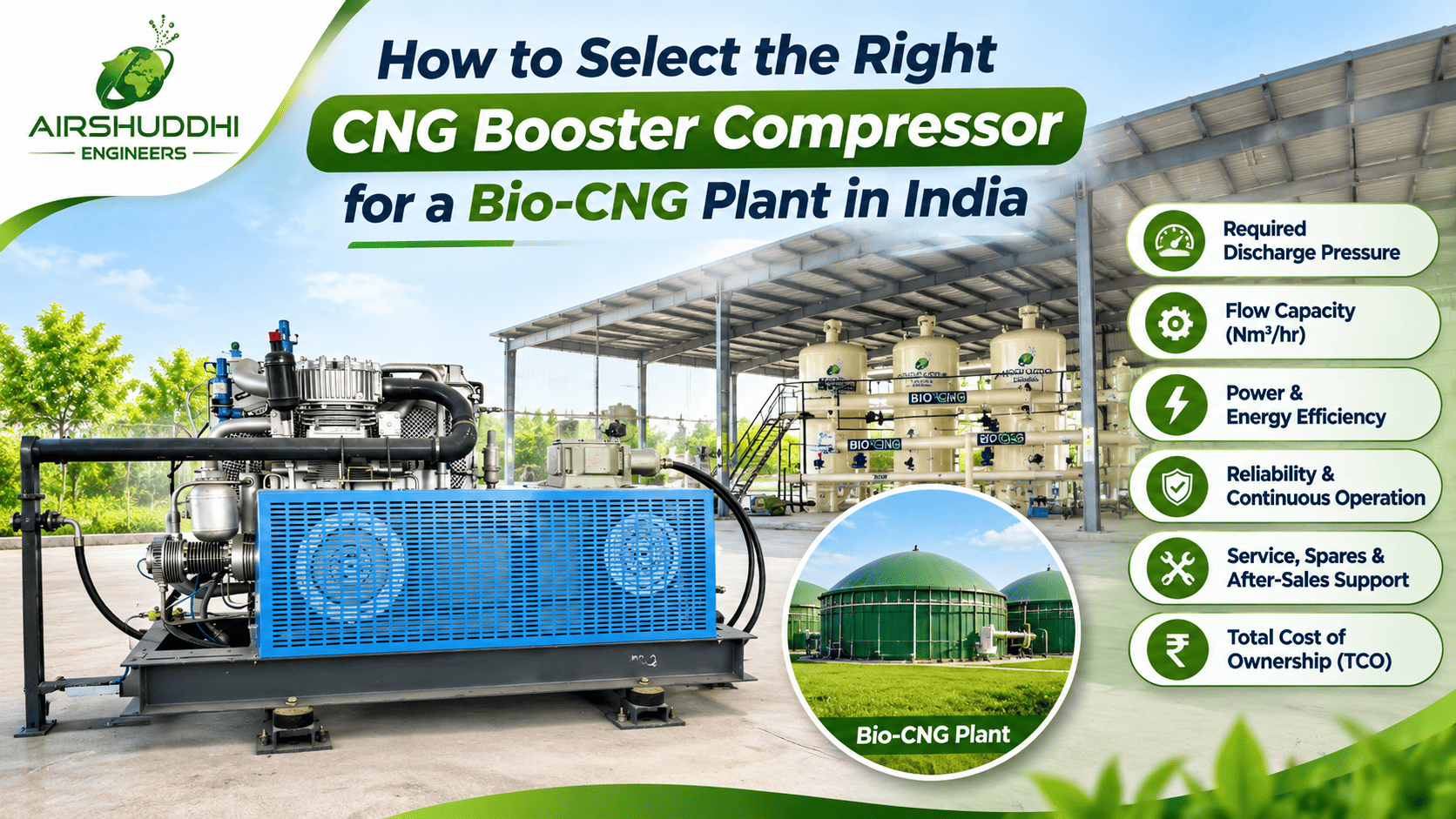
India's Bio-CNG industry is creating new opportunities for businesses investing in renewable fuel production, agricultural waste management and sustainable energy infrastructure. As Bio-CNG plants expand, selecting suitable gas compression equipment becomes an important part of project planning. A compressor must deliver the required gas flow and pressure while maintaining safe, stable and energy-efficient operation.
Choosing the right CNG Booster Compressor for Bio-CNG Plant applications involves more than comparing motor power or maximum discharge pressure. Project developers must evaluate gas composition, inlet pressure, required outlet pressure, operating capacity, compressor technology, cooling arrangements, safety controls and long-term maintenance requirements.
A properly selected Bio-CNG Compressor helps connect the gas production and upgrading section with downstream storage, cascade filling or other approved applications. This guide explains the important technical and practical considerations for selecting a suitable compressor for Bio-CNG projects in India.
A CNG booster compressor increases the pressure of gas so that it can be transferred, stored or supplied at the pressure required by the intended application.
In a Bio-CNG project, compression requirements depend on the plant configuration and the location of the compressor within the process. A compressor may be installed after gas upgrading to raise the pressure of purified biomethane for downstream high-pressure applications.
The compressor package may include:
Gas suction and discharge connections
Compression cylinders or compression elements
Electric motor or another suitable driver
Cooling arrangements
Gas filtration and associated piping
Pressure and temperature instruments
Control panel and safety interlocks
Pressure relief and emergency shutdown arrangements
The exact configuration should be determined from the project's process design and operating conditions. A compressor intended for one pressure range should not automatically be considered suitable for another.
Gas composition is one of the first technical inputs required for CNG Compressor Selection. Even when gas is described as Bio-CNG, its actual composition and quality should be confirmed through project-specific analysis.
The compressor supplier should receive information about the gas to be handled, including:
Methane concentration
Carbon dioxide content
Moisture level
Residual hydrogen sulphide (H₂S), where applicable
Oxygen and nitrogen content, where relevant
Potential liquid carryover
Gas temperature and pressure at the inlet
These parameters influence equipment compatibility, sealing arrangements, material selection, lubrication requirements and operating reliability.
For example, moisture or liquid carryover can affect compressor valves and internal components. Gas contaminants may also create corrosion or maintenance concerns depending on their concentration and the materials used.
Therefore, the project team should provide a representative gas analysis rather than selecting equipment using only an estimated methane percentage.
Compressor capacity determines how much gas the equipment can handle under specified operating conditions. Selecting an undersized compressor may restrict plant output, while an unnecessarily oversized machine can increase initial investment and operating expenses.
Before finalising a Biogas Booster Compressor or Bio-CNG compression package, evaluate:
Expected daily Bio-CNG production
Required hourly gas flow
Peak production conditions
Actual operating hours
Downstream storage or filling requirements
Future plant expansion plans
Variation in gas supply and consumption
Capacity is commonly expressed in standard cubic metres per hour (SCMH) or normal cubic metres per hour (Nm³/h). These units must be interpreted using the reference temperature and pressure specified in the technical datasheet.
A useful starting point is to estimate hourly flow from the expected daily production:
Required average flow = Daily gas production ÷ Operating hours per day
This calculation gives an initial average flow estimate. It is not a final compressor sizing calculation. The engineering team must also consider peak demand, inlet conditions, operating cycles, turndown and downstream requirements.
The supplier should provide performance data at the actual suction and discharge conditions rather than relying on a single headline capacity.
Pressure is a critical factor in selecting a High Pressure Gas Booster Compressor. The compressor must be designed to operate within the expected inlet-pressure range and achieve the required discharge pressure.
The project specification should clearly identify:
Inlet pressure
Minimum expected suction pressure
Normal operating suction pressure
Maximum suction pressure
Possible pressure fluctuations
Discharge pressure
Required operating outlet pressure
Maximum allowable discharge pressure
Pressure requirements of storage or filling equipment
Applicable design pressure of connected equipment
The difference between suction and discharge pressure determines the compression duty. A large pressure ratio may require multiple compression stages and suitable interstage cooling.
Do not select a compressor only because its advertised maximum discharge pressure matches the project requirement. Its capacity, power consumption and temperature performance must also be checked at the actual inlet pressure.
Different compressor designs serve different operating conditions. The appropriate technology depends on gas flow, pressure ratio, inlet conditions, duty cycle, maintenance resources and project economics.
A reciprocating compressor is commonly considered for high-pressure gas applications where the pressure ratio is substantial and the required flow is within the machine's suitable operating range.
During evaluation, compare:
Single-stage and multi-stage configurations
Lubricated and non-lubricated designs
Reciprocating or other suitable compression technologies
Variable operating conditions
Maintenance requirements
Available spare parts and technical support
A multi-stage arrangement can divide the overall compression duty across several stages. Interstage cooling helps manage gas temperature during compression.
The final decision should be based on the manufacturer's performance calculations and the specific Bio-CNG application, not on technology names alone.
Electricity consumption is a major consideration in the long-term economics of a Bio-CNG plant. A compressor with a lower purchase price may not necessarily deliver the lowest operating cost over its service life.
When evaluating an Industrial Gas Booster Compressor, examine:
Motor rating and actual absorbed power
Specific energy consumption
Efficiency at normal operating conditions
Pressure losses across filters and piping
Cooling-system power requirements
Part-load operating performance
Maintenance and replacement costs
Ask suppliers to provide power-consumption data at the specified suction pressure, discharge pressure and flow rate.
A variable-frequency drive (VFD) may be considered where the compressor design and operating requirements support variable-speed operation. However, its suitability must be confirmed by the equipment manufacturer.
For accurate comparison, assess the total cost of ownership, including equipment cost, electricity, routine servicing, spare parts, downtime and commissioning.
Gas temperature increases during compression. If temperature is not controlled properly, it can affect lubricant performance, sealing components, valves and overall equipment reliability.
A suitable compressor package may use air-cooled or water-cooled arrangements, depending on its design and site conditions.
Important evaluation points include:
Maximum permissible discharge temperature
Interstage cooling requirements
Aftercooler performance
Cooling-water availability, where required
Ambient temperature at the installation site
Temperature monitoring and shutdown protection
Indian operating conditions make ambient-temperature evaluation particularly important. Equipment should be assessed for the actual site environment rather than an assumed standard condition.
The compressor supplier should clearly specify cooling requirements, utility consumption and operating limitations.
Bio-CNG compression involves flammable gas and high-pressure equipment. Safety engineering must therefore be included from the initial equipment specification stage.
A properly engineered compressor package should be evaluated for suitable protection and monitoring systems, including:
Pressure relief valves
High discharge temperature shutdown
High and low inlet-pressure protection
Interstage and discharge-pressure monitoring
Cooling-system fault protection
Low lubricating-oil pressure shutdown, where applicable
Emergency shutdown arrangements
Gas leakage detection and suitable ventilation
Electrical equipment suitable for the classified hazardous area
Applicable Indian regulations and engineering standards must be assessed according to the actual installation, gas service and intended operation.
For example, PNGRB's technical and safety requirements for CNG retail outlets specify compressor-service design considerations and protective devices such as pressure relief valves, temperature shutdowns, pressure shutdowns and emergency isolation. The applicability of those provisions to a particular Bio-CNG installation must be checked rather than assumed.
The procurement team should request relevant design documents, equipment certifications, inspection records and testing documentation before commissioning.
A compressor should not be evaluated as an isolated machine. Its performance depends on the complete gas-handling arrangement connected to it.
A properly engineered CBG Gas Compression System may include:
Inlet isolation and filtration
Gas buffer or suction arrangements, where required
Compressor package
Interstage and aftercooling equipment
Pressure instruments and control systems
Discharge filtration, where required
Pressure relief and safety devices
Downstream storage or filling connections
Suitable piping, valves and fittings
The design should consider pressure losses, flow restrictions, access for maintenance and safe isolation.
The compressor's operating envelope must also match the downstream system. Storage vessels, cascades, filling equipment, pipelines and other connected components should be designed for their respective operating and design pressures.
Choosing a suitable CNG Booster Compressor Manufacturer in India is an important procurement decision. The supplier should be able to understand the project's process conditions and provide technical documentation that supports equipment selection.
Before placing an order, review the following:
Technical capability
Experience with the specified gas service
Ability to evaluate actual gas composition
Compressor performance calculations
Suitable pressure and capacity range
Package integration and instrumentation capability
Documentation
Technical datasheet
General arrangement drawing
Piping and instrumentation diagram (P&ID)
Motor and power requirements
Operating and maintenance manuals
Testing and inspection documentation
After-sales support
Availability of critical spare parts
Service response arrangements
Maintenance guidance
Operator training
Commissioning assistance
Do not compare quotations only by price. Two compressor packages may have different design conditions, rated capacities, accessories and safety provisions. A detailed technical comparison helps identify these differences before purchase.
Project developers can avoid unnecessary operating problems by addressing common procurement mistakes.
Selecting only by maximum pressure: Discharge pressure alone does not establish whether a compressor can deliver the required flow.
Ignoring gas composition: Gas quality and contaminants influence material compatibility and equipment design.
Using estimated capacity: Compressor sizing should be based on defined operating conditions and realistic production requirements.
Overlooking power consumption: Electricity costs can significantly affect long-term plant economics.
Ignoring cooling requirements: Inadequate cooling can create operating and maintenance problems.
Neglecting safety documentation: Protective systems, testing and applicable approvals should be reviewed before installation.
Not checking service support: Spare-part availability and technical assistance matter throughout the equipment's operating life.
A structured technical evaluation helps project owners make a more informed investment decision.
Airshuddhi Engineers, based in Ahmedabad, Gujarat, India, works in industrial gas engineering and renewable gas-related solutions. Its areas of business include biogas systems, gas purification, gas treatment and associated industrial gas equipment.
For Bio-CNG project developers evaluating a CNG Booster Compressor for Bio-CNG Plant, it is important to consider the compressor alongside the project's overall gas-handling requirements.
Before finalising an equipment configuration, project teams should prepare the gas composition, required flow, inlet pressure, discharge pressure, operating schedule and downstream application details.
Visit www.airshuddhi.com to learn more about Airshuddhi Engineers and its industrial gas solutions.
Selecting the right CNG Booster Compressor for Bio-CNG Plant applications requires a detailed understanding of gas quality, capacity, pressure, compression technology, cooling, energy consumption and safety requirements.
The most suitable compressor is not necessarily the one with the highest pressure rating or lowest purchase price. It is the equipment engineered to meet the project's actual operating conditions while supporting safe operation, reliable performance and manageable lifecycle costs.
Bio-CNG project developers should compare technical specifications, request performance data and evaluate the supplier's documentation and after-sales support before making a purchase decision. A well-planned CBG Gas Compression System can support dependable downstream gas handling and the long-term operation of renewable fuel infrastructure in India.
A CNG booster compressor increases the pressure of purified biomethane or Bio-CNG to meet the requirements of downstream applications such as high-pressure storage, cascade filling or gas supply systems. Its configuration depends on the plant's inlet pressure, required flow and discharge pressure.
Evaluate gas composition, inlet pressure, required discharge pressure, hourly flow, operating hours, power consumption, cooling requirements, safety features and maintenance support. Ask the supplier to provide performance data for the actual project conditions.
The suitable compressor depends on the required flow, pressure ratio, gas quality and operating conditions. Reciprocating multi-stage compressors are often evaluated for high-pressure applications, but final selection requires a project-specific engineering assessment.
The supplier generally requires:
Gas composition and quality
Minimum, normal and maximum inlet pressure
Required discharge pressure
Required flow in SCMH or Nm³/h
Gas inlet temperature
Operating hours and duty cycle
Site ambient conditions
Downstream application details
Multi-stage compression divides the total pressure increase across multiple stages. Interstage cooling can help control gas temperature and support the compressor's operating requirements. The number of stages depends on the pressure ratio, equipment design and application.
Energy consumption can be managed through correct compressor sizing, efficient motor selection, suitable operating pressure, reduced piping losses, appropriate maintenance and operation within the manufacturer's recommended range. Specific energy consumption should be compared at actual operating conditions.
Depending on the application and applicable requirements, safety provisions may include pressure relief valves, high-temperature shutdown, pressure monitoring, cooling-system protection, emergency shutdown, gas detection and suitable electrical equipment for hazardous areas.
A biogas compressor may handle raw or partially treated biogas at relatively low or intermediate pressure, depending on the process. A Bio-CNG compressor is generally designed for the compression duty associated with upgraded biomethane and its downstream application. Gas composition and pressure requirements determine equipment suitability.
Review the supplier's technical capability, gas-service suitability, performance calculations, rated capacity, pressure range, power requirements, safety systems, documentation, testing procedures, spare-parts availability and after-sales support.
No. Bio-CNG plants can have different production capacities, gas inlet pressures, discharge requirements and operating schedules. Compressor selection should be based on the specific process conditions and downstream system design.
Compressor capacity and power consumption can change with suction pressure, gas temperature and other operating conditions. A performance guarantee at a different inlet condition may not represent the equipment's actual output at the project site.
Project developers can explore industrial gas engineering and renewable gas solutions from Airshuddhi Engineers, Ahmedabad, Gujarat, through www.airshuddhi.com. Equipment requirements should be discussed with the technical team using project-specific gas and pressure data.