Call Us

-
-
-
Office Address
401 & 402, Smart Walls, Nr Science City Circle, SP Ring Road, Ahmedabad-380060, Gujarat (INDIA)
Office Address
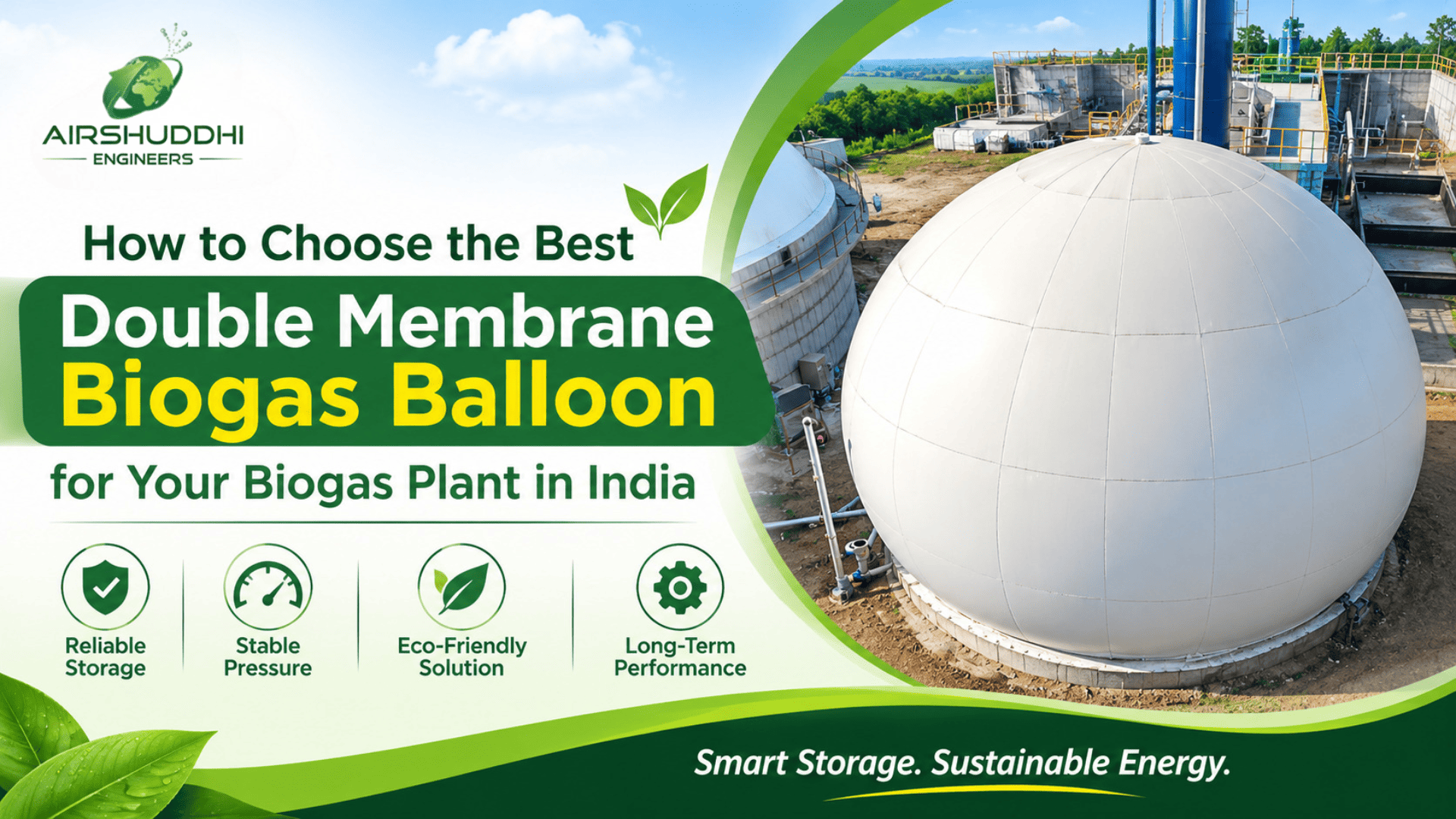
Choosing the right gas storage system is an important decision when planning a commercial or industrial biogas project. A suitable storage solution helps manage variations in gas production, maintain a consistent supply to downstream equipment and support reliable plant operations. One commonly considered option for these requirements is a Double Membrane Biogas Balloon.
For biogas plant owners, EPC contractors and renewable energy project developers, selecting a gas holder involves more than comparing prices or storage volumes. Factors such as membrane quality, usable storage capacity, operating pressure, weather resistance, installation requirements and maintenance support all influence long-term performance.
As India's biogas and Compressed Biogas (CBG) sector continues to develop, demand for dependable biogas storage solutions in India is also becoming increasingly important. Whether you are developing an agricultural biogas facility, an industrial waste-to-energy project or a Bio-CNG production plant, understanding the technical requirements of a double membrane gas holder can help you make a better purchasing decision.
In this guide, we explain how to evaluate a Double Membrane Biogas Balloon, which features to consider and how to select a suitable manufacturer for your project.
A Double Membrane Biogas Balloon is a flexible gas storage system designed to temporarily store biogas generated by anaerobic digestion. It generally consists of an inner gas-holding membrane and an outer supporting membrane.
The inner membrane contains the biogas, while the outer membrane helps maintain the structure and shape of the gas holder. A controlled supply of air into the space between the two membranes creates the supporting pressure required to maintain the holder's shape.
Depending on the project design, double membrane gas holders can be installed as standalone storage units or integrated with suitable digester structures.
They are considered for different types of projects, including:
Agricultural waste-based biogas plants
Industrial organic waste treatment facilities
Municipal solid waste processing plants
Food processing and agro-industrial units
Bio-CNG and CBG production facilities
Wastewater treatment and sewage-based biogas projects
The correct configuration depends on the plant's gas production profile, storage requirement, site conditions and engineering design.
Before approaching a Top Double Membrane Biogas Balloon Manufacturer in India, determine how much gas your plant needs to store.
A gas holder should be selected according to the difference between biogas production and consumption over time. For example, a digester may produce gas continuously, while a biogas upgrading unit, boiler or generator may operate according to a different schedule.
The storage system helps manage this difference.
Consider the following factors:
Daily biogas production: Estimate the expected gas generation from the digester.
Hourly gas production: Understand how production changes throughout the day.
Gas consumption pattern: Identify when downstream equipment uses the gas.
Required storage duration: Determine how much temporary buffering the plant needs.
Operating reserve: Consider planned maintenance and temporary interruptions.
Future expansion: Evaluate whether additional production capacity is expected.
Do not select a balloon based only on the plant's daily gas production. The required usable storage volume should be calculated from production and consumption profiles, operating limits and the project's contingency requirements.
Membrane quality directly affects the durability, gas containment and operational reliability of a gas holder.
A Best Double Membrane Biogas Holder Manufacturer in India should be able to provide technical details about the membrane material used in the proposed system.
Many engineered double membrane gas holders use reinforced, coated technical fabrics. However, the exact material specification should be selected according to the gas composition, operating environment and project requirements.
Important material characteristics include:
The membrane must withstand the mechanical forces created during inflation, deflation and normal operation. Review the manufacturer's technical data for tensile strength, tear resistance and seam performance.
Biogas balloons are often installed outdoors and remain exposed to sunlight. UV-resistant materials and suitable protective coatings help reduce premature deterioration.
The membrane should provide suitable gas containment characteristics. Ask the manufacturer for relevant gas permeability data and testing documentation.
Raw biogas can contain moisture, hydrogen sulphide and other impurities. The selected material must be compatible with the expected operating conditions.
For Indian installations, consider high temperatures, seasonal rainfall, humidity, dust and wind exposure.
Do not evaluate membrane quality based only on appearance or thickness. Request technical specifications and supporting test documents before finalising the equipment.
A double membrane gas holder is not simply a flexible balloon. It is an engineered assembly in which the membranes, air supply, monitoring equipment and safety arrangements work together.
Before selecting a Top Biogas Storage Balloon Manufacturer in India, understand the major system components.
Important components generally include:
Inner membrane: Provides the gas storage enclosure.
Outer membrane: Maintains the external shape and protects the internal structure.
Air blower: Supplies supporting air to the space between the membranes, as required by the design.
Pressure monitoring system: Helps monitor operating conditions.
Pressure and vacuum protection: Protects the system against pressure conditions outside its permitted operating range.
Gas inlet and outlet connections: Connect the holder with the plant's gas pipeline.
Level or volume monitoring: Helps operators understand the quantity of gas stored.
Condensate management: Supports appropriate handling of moisture in connected gas lines.
The final equipment configuration should be confirmed through the manufacturer's engineering drawings and project-specific technical specifications.
Storage capacity and operating pressure are two important parameters when choosing a Double Membrane Biogas Balloon.
A system with insufficient usable capacity may not provide the required buffering during changes in gas production or consumption. An oversized system, on the other hand, may increase the initial investment without providing meaningful operational benefits.
Discuss the following details with the manufacturer:
Required nominal storage volume
Actual usable storage volume
Minimum and maximum operating levels
Normal operating pressure
Permitted pressure range
Gas inlet and outlet flow requirements
Pressure protection arrangements
Connection sizes and pipeline requirements
It is also important to understand that a double membrane gas holder is generally a low-pressure storage and buffering system. It should not be confused with a high-pressure CBG storage vessel or compressor cascade.
If your project includes biogas upgrading and compression, the gas holder should be designed in coordination with the downstream equipment.
India has diverse climatic conditions. A gas storage system installed in Gujarat may experience different environmental conditions from one installed in northern, coastal or eastern India.
Therefore, the installation location should be considered during equipment selection.
Important site-related factors include:
Maximum and minimum ambient temperatures
Exposure to direct sunlight
Monsoon rainfall and drainage arrangements
Local wind conditions
Foundation and anchoring requirements
Available installation area
Access for inspection and maintenance
Distance from other plant equipment
For projects in Gujarat and other regions with high outdoor temperatures, UV resistance and suitable material selection deserve particular attention.
Similarly, installations in areas with heavy seasonal rainfall require proper site drainage and protection against water accumulation around the foundation.
A Trusted Biogas Storage Solutions India provider should consider these site conditions during the engineering and installation planning stages rather than relying on a standard configuration for every project.
Safety should be a major consideration when purchasing a biogas storage system. Biogas contains methane, which is combustible, and may also contain hydrogen sulphide, which is toxic.
The storage system must therefore be designed, installed and operated with suitable safety arrangements.
Before approving a supplier, discuss:
Pressure and vacuum protection
Gas leakage inspection procedures
Appropriate ventilation and hazardous-area assessment
Safe electrical and blower arrangements
Emergency isolation provisions
Gas detection requirements where specified by the project design
Safe venting and emergency gas-handling arrangements
Inspection and maintenance procedures
Modern biogas projects are also increasingly interested in real-time pressure monitoring, gas-level measurement and automated plant monitoring.
Where suitable, instrumentation can help operators identify abnormal operating conditions and manage storage more effectively. However, monitoring equipment does not replace correctly engineered mechanical protection or regular inspection.
The installation configuration should match the plant layout and engineering requirements.
Two common arrangements are ground-mounted and digester-mounted double membrane gas holders.
Ground-Mounted Double Membrane Gas Holder
Installed separately from the digester.
Can be considered where independent gas storage is required.
Requires suitable foundation and anchoring arrangements.
Needs appropriate gas pipeline connections and maintenance access.
Digester-Mounted Double Membrane Gas Holder
Integrated with a suitable digester structure.
Can combine the gas storage arrangement with the digester installation.
Requires careful consideration of structural support and connection details.
Must be compatible with the digester's engineering design.
Neither arrangement is automatically suitable for every project. Compare site availability, structural requirements, storage needs and maintenance access before making a decision.
The purchase price is only one part of the total cost of owning a gas storage system.
A low-cost gas holder may become expensive if it requires frequent repairs, has unsuitable membrane material or does not include adequate technical support.
When evaluating a Top Biogas Balloon Supplier in India, ask about its maintenance recommendations and after-sales services.
Important maintenance considerations include:
Regular visual inspection of membrane surfaces
Checking seams, joints and connection points
Monitoring air blower performance
Inspecting pressure and level instruments
Checking gas pipeline connections
Maintaining drainage and condensate arrangements
Reviewing protective equipment and safety devices
Following the manufacturer's inspection schedule
The maintenance schedule should be based on the actual equipment design and operating conditions. Repairs and membrane replacement should be performed by qualified personnel using approved procedures.
Also compare warranty conditions, spare-part availability, service response and commissioning support.
Selecting a manufacturer is as important as selecting the gas holder itself.
If you are searching for the Best Biogas Gas Holder Manufacturer near me, do not make your decision based only on location or price. Evaluate the supplier's engineering capability and ability to meet your project's technical requirements.
Before finalising your order, ask the manufacturer for:
Product technical specifications
Membrane material details
Storage capacity and operating pressure information
General arrangement and foundation drawings
Blower and instrumentation details
Quality inspection and testing documentation
Installation and commissioning scope
Warranty terms
After-sales support arrangements
You can also compare quotations from Top Biogas Storage Tank Manufacturers and Suppliers in India by checking whether the proposed systems have the same storage volume, scope of supply, instrumentation and installation responsibilities.
A technically detailed quotation makes it easier to compare suppliers fairly.
Airshuddhi Engineers is based in Ahmedabad, Gujarat, India, and works in the renewable gas and industrial gas equipment sector.
The company provides solutions across different stages of biogas and industrial gas projects, including biogas generation, purification, upgrading and associated gas handling systems.
For project developers looking for a Double Membrane Biogas Balloon, it is important to discuss the storage requirement alongside the overall plant configuration.
Airshuddhi Engineers can be contacted to discuss project requirements and suitable equipment solutions.
When discussing your requirement, share:
Type of biogas plant
Expected daily and hourly gas production
Required storage volume
Raw biogas composition, if available
Proposed installation location
Ground-mounted or digester-mounted preference
Project drawings and equipment details, if available
This information helps establish the technical requirements for evaluating a suitable gas storage solution.
Contact Airshuddhi Engineers
Website: www.airshuddhi.com
Email: info@airshuddhi.com
Location: Ahmedabad, Gujarat, India
India's renewable gas sector is developing alongside growing interest in waste-to-energy projects, agricultural residue utilisation and compressed biogas production.
The expansion of CBG infrastructure is increasing the importance of reliable gas handling, storage, monitoring and maintenance systems.
Some important areas receiving attention include:
CBG Plant Integration: Gas storage systems need to coordinate with upgrading, compression and downstream gas utilisation equipment.
Digital Monitoring: Pressure measurement, gas-level monitoring and automated plant controls can help operators manage storage conditions.
Methane Leakage Prevention: Better material selection, inspection practices and gas containment procedures are important for reducing avoidable methane losses.
Climate-Resistant Membranes: UV protection, weather resistance and material durability are important considerations for outdoor installations across India.
Lifecycle Cost Evaluation: Project developers are increasingly encouraged to consider maintenance, replacement requirements and operational support rather than comparing only initial equipment prices.
These developments make the selection of a suitable Double Membrane Biogas Balloon an important part of planning reliable biogas and CBG infrastructure.
Selecting the right Double Membrane Biogas Balloon requires careful evaluation of storage capacity, membrane material, operating pressure, supporting equipment, site conditions and long-term maintenance requirements.
For biogas plant owners and EPC contractors, the right gas holder should be selected according to the actual production and consumption profile of the project. It should also be compatible with the plant's gas treatment equipment and designed with appropriate safety and monitoring arrangements.
Whether you are developing an agricultural biogas facility, an industrial waste-to-energy project or a CBG production plant, compare manufacturers on technical capability, material quality, engineering documentation and after-sales support.
Airshuddhi Engineers, based in Ahmedabad, Gujarat, India, can be contacted to discuss biogas equipment and project requirements.
Visit www.airshuddhi.com to learn more about the company's renewable gas and industrial gas solutions.
A Double Membrane Biogas Balloon is used to store biogas temporarily and manage variations between gas production and consumption. It can support biogas plants, industrial waste-to-energy facilities and suitable CBG projects.
It generally uses an inner gas-holding membrane and an outer supporting membrane. A controlled air supply between the membranes maintains the structure, while the inner membrane stores the biogas.
Capacity should be calculated using the plant's hourly gas production and consumption profiles, required storage duration, usable operating range and contingency requirements. Daily production alone is not sufficient for accurate sizing.
The material should offer suitable tensile strength, tear resistance, gas containment, UV protection and compatibility with the expected biogas conditions. Ask the manufacturer for technical specifications and relevant test documentation before selecting a material.
Yes. It can be used as a low-pressure biogas storage or buffering component in a suitably designed CBG plant. It is not a replacement for high-pressure CBG storage vessels or compressor cascades.
A ground-mounted gas holder is installed separately from the digester, while a digester-mounted system is integrated with a suitable digester structure. The choice depends on plant layout, structural design, storage requirements and maintenance access.
Maintenance generally includes inspecting membrane surfaces, seams, connections, blower operation, pressure instruments and safety equipment. The manufacturer should provide an inspection and maintenance schedule based on the specific design.
Compare manufacturers based on membrane specifications, engineering capability, storage capacity, safety arrangements, technical documentation, installation support, warranty and after-sales service. Do not select a supplier based only on the lowest quotation.
It can be suitable when designed for the site's climatic and environmental conditions. UV resistance, temperature suitability, wind loading, drainage, anchoring and installation quality should all be evaluated.
Share the plant's gas production rate, required storage volume, gas composition, operating pressure, installation location, preferred configuration and available project drawings. These details help the supplier assess the requirement.