Call Us

-
-
-
Office Address
401 & 402, Smart Walls, Nr Science City Circle, SP Ring Road, Ahmedabad-380060, Gujarat (INDIA)
Office Address
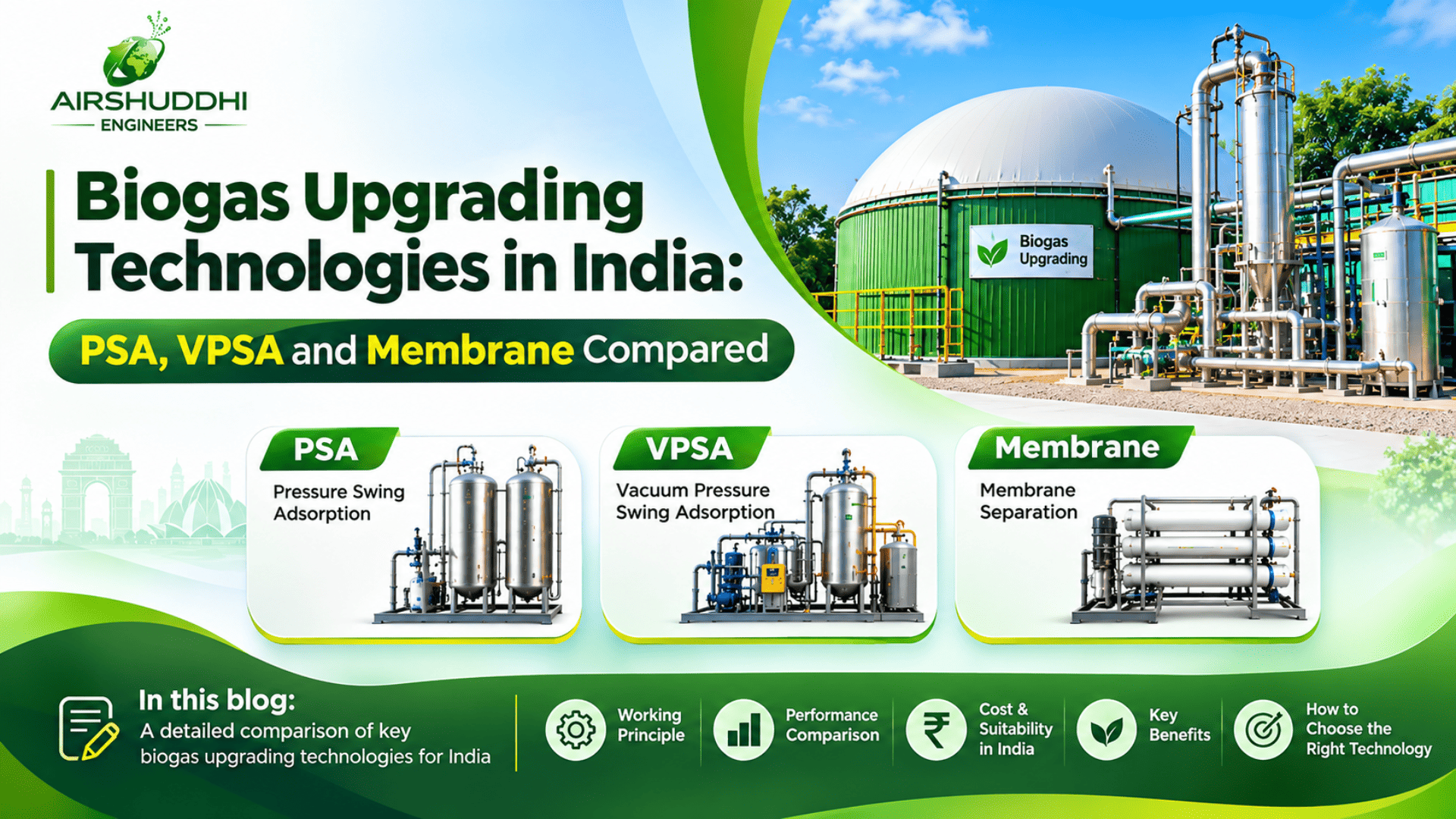
India's renewable energy sector is witnessing growing interest in converting organic waste into clean, usable fuel. With the expansion of Compressed Biogas (CBG), Bio-CNG and biomethane projects, selecting the right Biogas Upgrading Technology in India has become an important consideration for project developers, industries, EPC contractors and investors. Technologies such as Pressure Swing Adsorption (PSA), Vacuum Pressure Swing Adsorption (VPSA) and membrane-based gas separation offer different approaches to removing carbon dioxide and other unwanted components from raw biogas.
Although all three technologies aim to increase methane concentration, their operating principles, energy requirements, process configurations and suitability can vary. Understanding these differences helps businesses select a system according to feed gas composition, production capacity, required methane recovery, final gas quality and operating conditions.
Airshuddhi Engineers, based in Ahmedabad, Gujarat, India, works in industrial gas treatment and biogas purification solutions. Its portfolio includes biogas purification plants, VPSA biogas purification systems, H₂S scrubbers, membrane biogas separation technology and related gas-handling equipment.
This guide compares PSA, VPSA and membrane technologies and explains the important factors to consider before selecting a biogas upgrading plant.
Biogas is produced through the anaerobic digestion of organic materials such as agricultural residues, cattle dung, food waste, municipal organic waste and industrial wastewater. Raw biogas generally contains methane (CH₄), carbon dioxide (CO₂), water vapour and trace contaminants such as hydrogen sulphide (H₂S).
The methane content determines the fuel value of biogas. However, raw biogas may not meet the quality requirements for applications such as vehicle fuel, pipeline injection or other commercial uses.
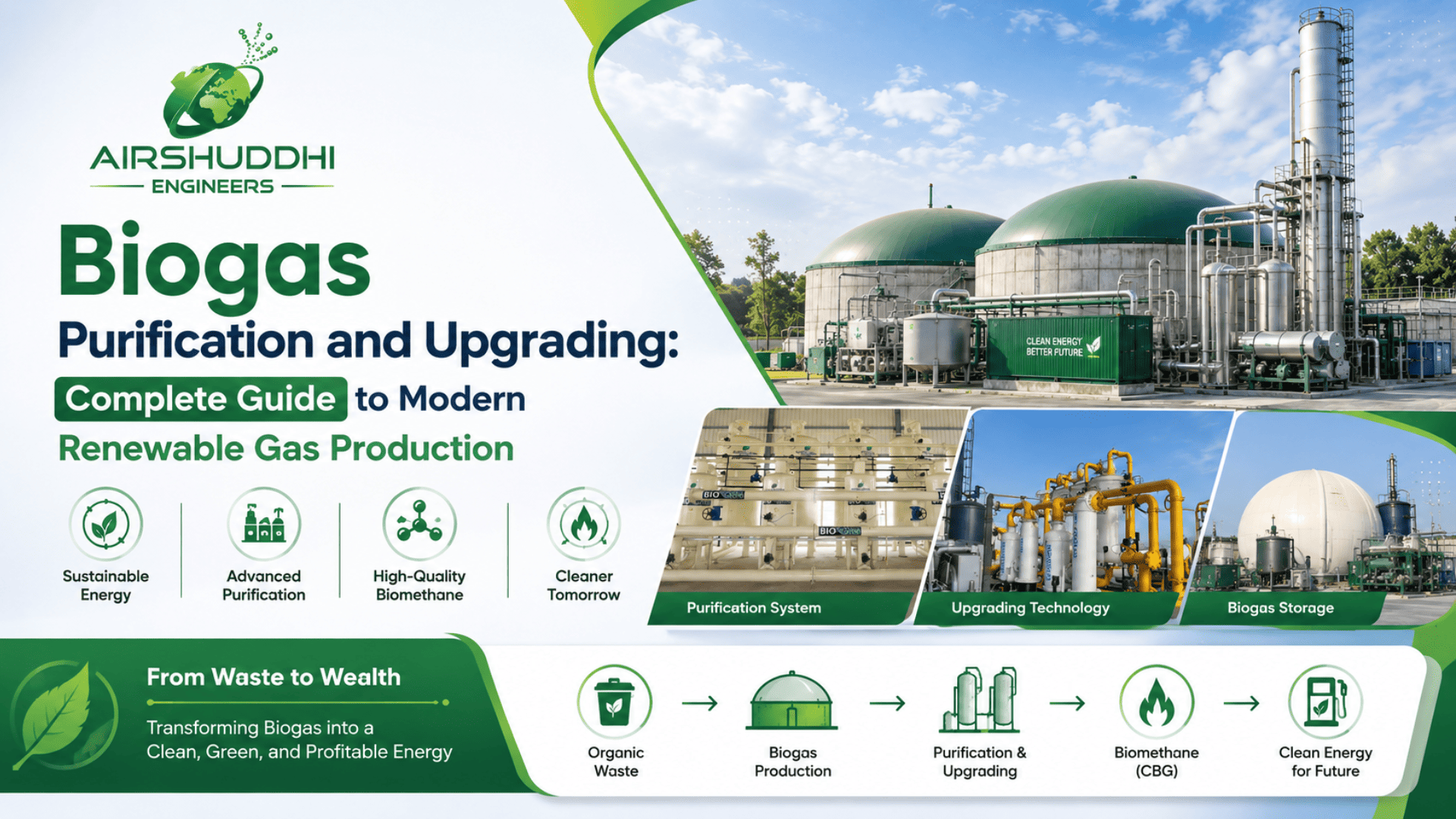
Biogas upgrading is the process of separating carbon dioxide and other unwanted components to produce a methane-rich gas known as biomethane or upgraded biogas.
Depending on the intended application, a complete upgrading system may include:
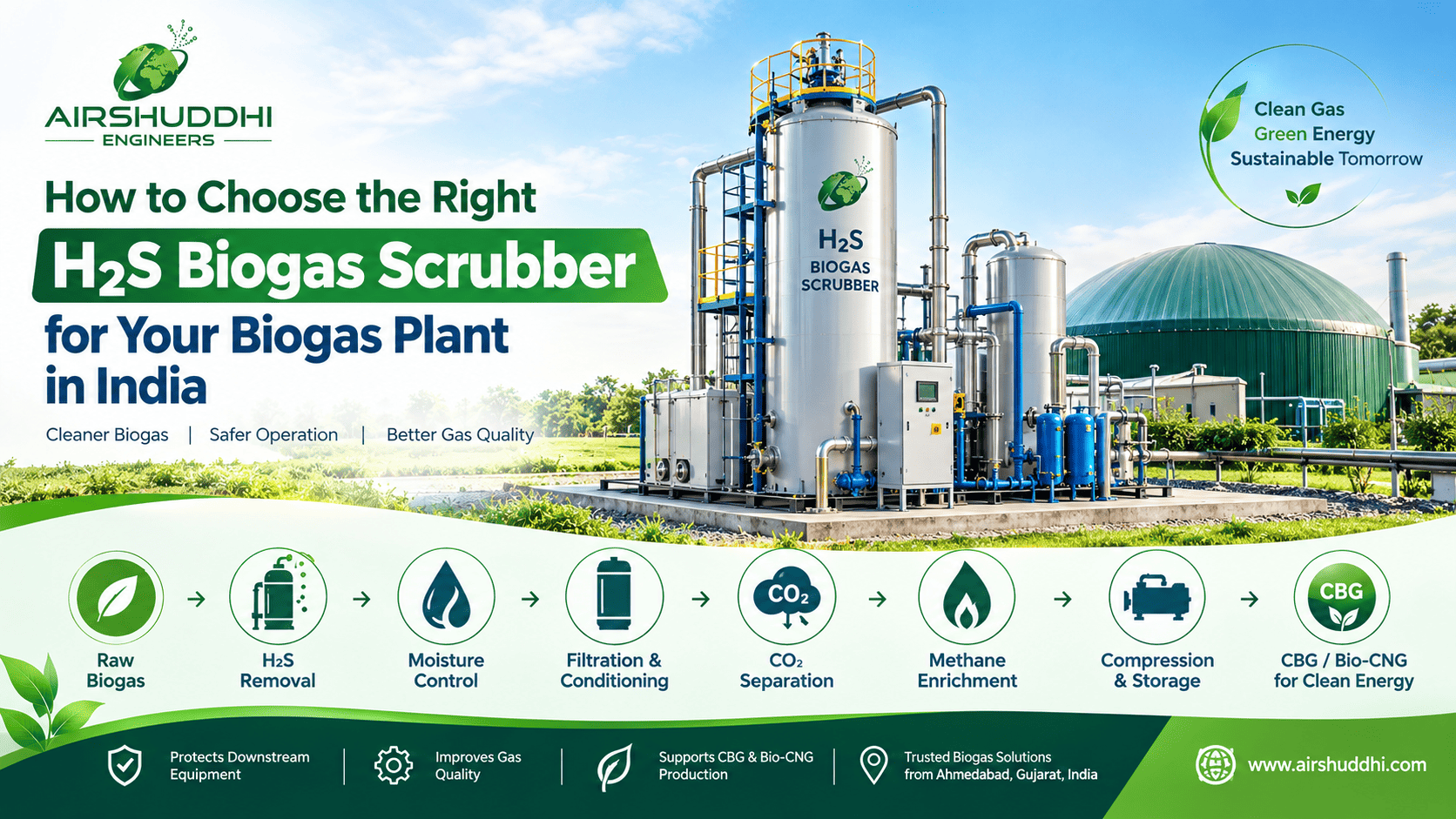
Raw biogas cooling and moisture removal.
Hydrogen sulphide removal.
Fine filtration and contaminant treatment.
Carbon dioxide separation.
Methane recovery and gas quality monitoring.
Compression and storage, where required.
The final gas specification must be determined according to the applicable end-use requirements and relevant standards. A technology that works well for one project may not be the most economical or technically suitable for another.
Three widely discussed approaches for commercial biogas upgrading are PSA, VPSA and membrane separation.
Each technology uses a different physical principle to separate methane from carbon dioxide.
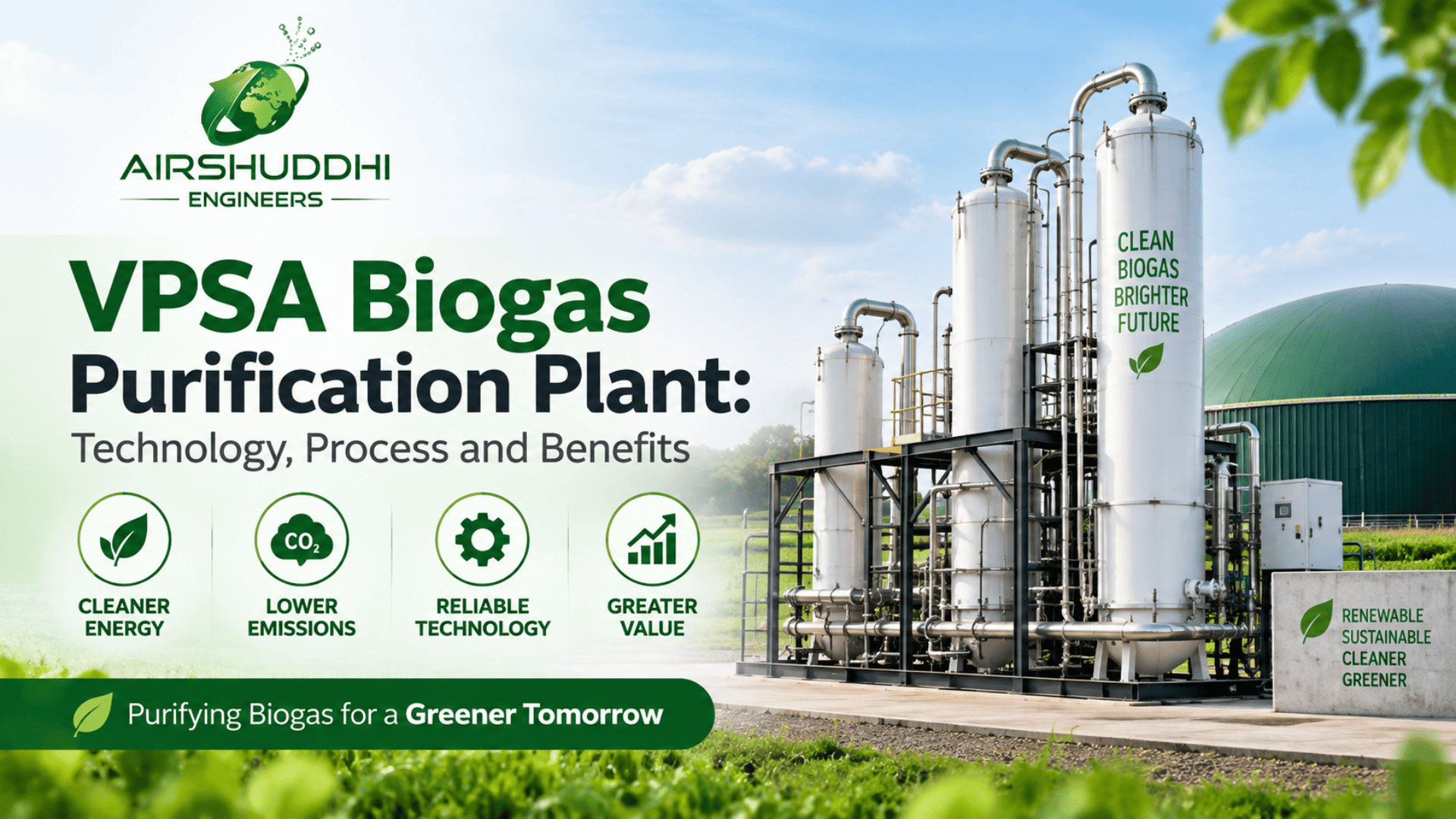
PSA uses specially selected adsorbent materials to capture certain gas components under pressure. During operation, carbon dioxide and other adsorbable impurities are retained by the adsorbent, while methane-rich gas passes through the system.
The pressure is subsequently reduced to regenerate the adsorbent and release the retained gases. Multiple adsorption vessels operate in a coordinated sequence to maintain continuous gas treatment.
Key characteristics of PSA technology:
Uses adsorption and pressure cycling for gas separation.
Requires suitable adsorbent materials and process controls.
Can be configured for different gas flow capacities.
Needs appropriate pretreatment to protect the adsorbent.
Requires careful management of pressure, cycle timing and gas quality.
PSA technology is also widely used in industrial gas generation. A PSA Nitrogen Gas Plant separates nitrogen from compressed air, while a PSA Oxygen Gas Plant produces oxygen-enriched gas using a different adsorbent configuration and process design.
Although these systems use the same broad pressure-swing principle, their adsorbents, process configurations and product specifications differ. An oxygen or nitrogen generation system should not be treated as interchangeable with a biogas upgrading plant.
VPSA is a pressure-swing adsorption process that uses vacuum during the regeneration stage. Instead of relying only on pressure reduction, the system applies vacuum to help remove adsorbed components from the adsorbent.
For biogas upgrading, VPSA systems can be designed to separate carbon dioxide from methane using suitable adsorbents and process arrangements.
Key characteristics of VPSA technology:
Combines adsorption under pressure with vacuum-assisted regeneration.
Requires vacuum equipment and coordinated process controls.
Can be engineered for continuous gas processing.
Needs suitable feed gas pretreatment.
Performance depends on adsorbent selection, operating conditions and system design.
A Best VPSA Biogas Purification Plant in India should not be selected only on the basis of its advertised methane purity. Buyers should evaluate methane recovery, energy consumption, gas losses, availability, maintenance requirements and performance under actual feed gas conditions.
VPSA is also used in oxygen generation applications. A VPSA Oxygen Gas Plant is designed to separate oxygen from air and has a different process objective from a VPSA biogas purification system.
Membrane-based upgrading uses selective gas permeation to separate methane from carbon dioxide. Different gases pass through a membrane at different rates because of differences in their permeability and interaction with the membrane material.
In a typical system, compressed and pretreated biogas passes through membrane modules. Carbon dioxide and certain other gases permeate through the membrane more readily, while the retained stream becomes richer in methane.
Depending on the required gas quality and methane recovery, the plant may use multiple membrane stages, recycle streams and additional treatment equipment.
Key characteristics of membrane technology:
Uses selective gas permeation rather than adsorption.
Can be designed with modular membrane units.
Supports staged separation and process optimisation.
Requires suitable feed gas compression and pretreatment.
Membrane performance depends on gas composition, pressure, temperature and operating conditions.
Membrane Biogas Separation Technology is an important option for project developers seeking modular upgrading systems. However, membrane selection should consider methane recovery, membrane life, gas losses, replacement costs and the quality of the incoming biogas.
The most suitable technology depends on the specific project rather than a universal ranking.
| Evaluation factor | PSA | VPSA | Membrane |
| Separation principle | Adsorption | Adsorption with vacuum regeneration | Selective gas permeation |
| Main equipment | Adsorption vessels, valves and controls | Adsorption vessels, vacuum equipment and controls | Compressors, membrane modules and controls |
| Process requirements | Pressure cycling | Pressure and vacuum cycling | Gas pressure and membrane staging |
| Pretreatment | Important | Important | Important |
| System configuration | Depends on capacity and design | Depends on capacity and design | Modular configurations are possible |
| Maintenance focus | Adsorbent, valves and cycle controls | Adsorbent, vacuum equipment and controls | Membrane condition, filters and compressors |
| Key performance checks | Purity, recovery and energy use | Purity, recovery and energy use | Purity, recovery and methane losses |
Before choosing a plant, compare the following technical and commercial parameters:
Methane recovery: How much methane is retained in the upgraded product gas?
Methane concentration: Does the system consistently meet the required gas specification?
Energy consumption: What is the total electricity requirement per unit of upgraded gas?
Feed gas flexibility: Can the system handle expected variations in raw biogas composition?
Pretreatment requirements: What level of moisture, H₂S and contaminant removal is necessary?
Plant availability: What maintenance and shutdown arrangements are required?
Operating cost: What are the costs of electricity, consumables, replacement parts and servicing?
Expansion potential: Can the plant be upgraded if production capacity increases?
A reliable comparison should use the same feed gas composition, flow rate, product gas specification and operating assumptions for all technology quotations.
Selecting the Best Biogas Upgrading Technology in India requires a technical assessment of the complete project. The cheapest equipment quotation may not deliver the lowest lifetime operating cost.
Consider these steps before finalising a technology:
Start with a detailed gas analysis covering:
Methane concentration.
Carbon dioxide concentration.
Hydrogen sulphide levels.
Moisture content.
Oxygen and nitrogen, where relevant.
Siloxanes and other contaminants, if present.
Feed gas analysis helps determine the pretreatment and separation requirements.
Identify the final application, such as:
Compressed Biogas (CBG) production.
Bio-CNG applications.
Industrial fuel.
Biomethane supply.
Pipeline injection, subject to applicable specifications.
The required gas quality should guide the process design.
A system may produce high methane purity but still lose a significant amount of methane in its off-gas stream. Therefore, compare both product purity and methane recovery.
Ask manufacturers to provide performance guarantees under clearly defined operating conditions.
Evaluate electricity consumption for compressors, vacuum pumps, cooling equipment and other auxiliaries. Also consider adsorbent replacement, membrane replacement, filters, maintenance labour and spare parts.
A modern upgrading plant should have suitable instrumentation, gas analysers, alarms, pressure protection, emergency shutdown arrangements and control systems.
The plant design must follow applicable safety requirements and site-specific regulations.
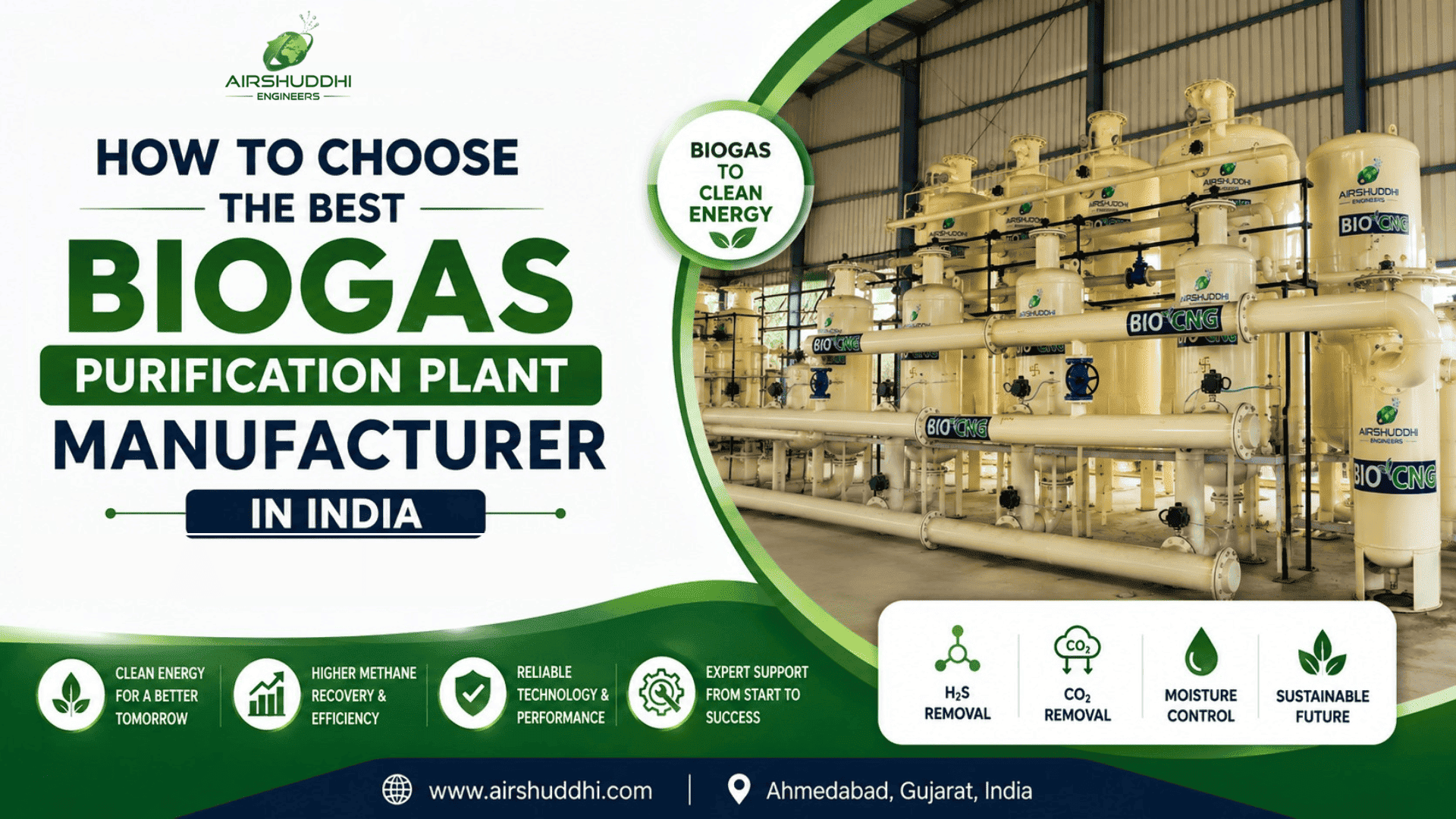
Choosing a capable Biogas Upgradation Plant Manufacturer is as important as selecting the separation technology. The supplier should understand the complete gas-treatment process rather than focusing only on one piece of equipment.
Evaluate a manufacturer based on:
Experience in biogas treatment and gas separation.
Engineering and process design capabilities.
Availability of PSA, VPSA or membrane-based solutions.
Raw biogas pretreatment and H₂S removal expertise.
Equipment manufacturing and integration capabilities.
Automation, monitoring and gas quality testing.
Installation and commissioning support.
After-sales service and availability of spare parts.
Documented project references and technical performance data.
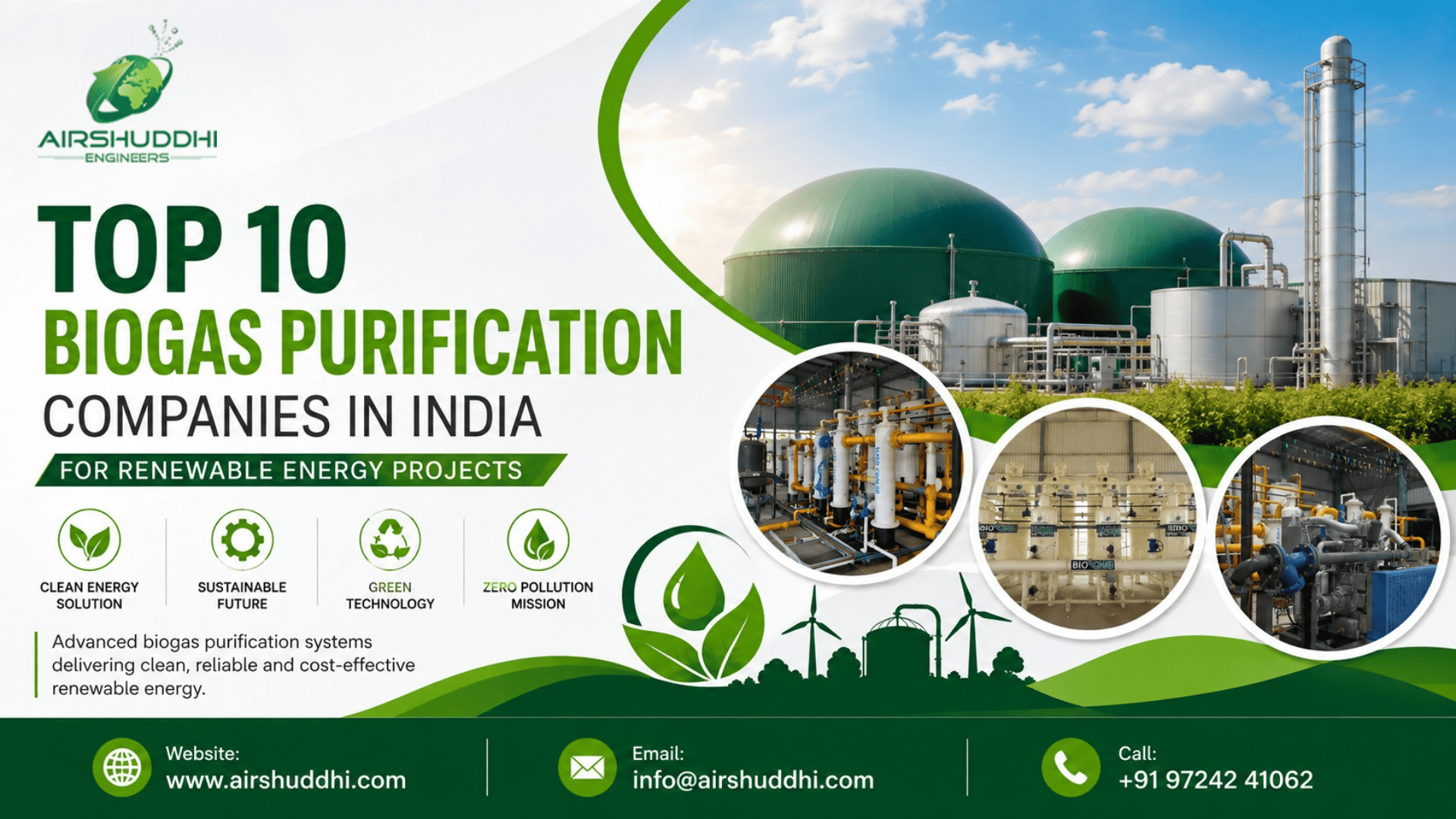
Businesses searching for Best Biogas Purification and Upgrading Companies in India should compare actual project capabilities, engineering support and long-term service arrangements rather than relying only on promotional claims.
A successful upgrading project involves more than the separation unit. Several supporting systems help maintain stable operation and manage gas safely.
Hydrogen sulphide can cause corrosion and damage downstream equipment. An appropriately designed H₂S removal system helps reduce this contaminant before the gas enters sensitive treatment equipment.
The selection of an H₂S scrubber depends on inlet concentration, flow rate, removal target and the overall process configuration.
Biogas production and consumption may not always occur at the same rate. Gas storage helps balance these variations and provides a buffer for plant operation.
A double membrane gas holder generally uses an inner membrane to contain gas and an outer membrane to maintain the required structural shape and operating arrangement. The exact configuration depends on design pressure, capacity, site conditions and safety requirements.
When evaluating a Top Double Membrane Biogas Balloon Manufacturer in India or Best Double Membrane BioGas Holder Manufacturer in India, check:
Storage capacity and operating pressure.
Membrane material and durability.
Weather and UV resistance.
Blower and pressure-control arrangements.
Safety devices and monitoring systems.
Installation and maintenance support.
Some biogas project developers also require industrial gas generation equipment for other plant operations.
A PSA Nitrogen Gas Plant may be used where nitrogen is required for an industrial process. A PSA Oxygen Gas Plant may serve applications requiring oxygen generation, while a VPSA oxygen system may be considered for suitable larger-scale requirements.
These systems have separate process requirements and should be specified according to their intended applications.
India's CBG and renewable gas ecosystem is evolving as businesses explore cleaner fuel alternatives, organic waste utilisation and circular economy opportunities.
Several developments are influencing technology selection and project planning.
CBG projects require coordinated planning across feedstock handling, anaerobic digestion, gas cleaning, upgrading, compression and dispensing or distribution. Developers increasingly need integrated solutions rather than isolated equipment packages.
Methane losses can affect both project economics and environmental performance. Better gas monitoring, leak detection, process optimisation and off-gas management are becoming important considerations.
Modern plants can use PLC-based controls, online gas analysers, alarms and operational dashboards to monitor critical process parameters.
Digital monitoring can help operators identify performance changes, plan maintenance and maintain consistent gas quality. However, automation does not replace proper engineering, inspection and operator training.
Modular equipment arrangements can help project developers plan capacity in stages. The feasibility of expansion depends on the original process design, available utilities, site layout and feedstock availability.
AI-assisted analytics and predictive maintenance are emerging areas in industrial operations. When supported by reliable sensor data, these tools may help identify unusual operating patterns and maintenance needs. They should be viewed as supporting tools, not substitutes for validated process controls.
CBG and biomethane projects must consider applicable gas quality, safety, environmental and statutory requirements. Specifications may vary according to the intended use and receiving infrastructure. Project developers should confirm current requirements with the relevant authorities and technical stakeholders before commissioning.
Airshuddhi Engineers, located in Ahmedabad, Gujarat, India, works in industrial gas treatment and biogas purification solutions. The company offers equipment and systems for businesses exploring renewable gas production and industrial gas applications.
Its product portfolio includes:
Biogas Purification Plants.
VPSA Biogas Purification Plants.
H₂S Biogas Scrubbers.
Membrane Biogas Separation Technology.
CNG Booster Compressors.
Double Membrane Biogas Balloons.
PSA Nitrogen Gas Plants.
PSA Oxygen Gas Plants.
VPSA Oxygen Gas Plants.
Air Dryers and Pressure Vessels.
Carbon Molecular Sieve.
For developers comparing Top PSA Oxygen Gas Plant Manufacturer in India, Best VPSA Oxygen Gas Plant in Gujarat India or biogas upgrading suppliers, it is important to evaluate each product category according to its actual application and technical specifications.
Airshuddhi Engineers can be considered when evaluating biogas purification and related gas-treatment equipment. Project developers should share their raw gas analysis, required output quality, capacity and site conditions to identify a suitable system configuration.
Company: Airshuddhi Engineers
Location: Ahmedabad, Gujarat, India
Website: https://www.airshuddhi.com/
PSA, VPSA and membrane separation technologies each offer a different approach to biogas upgrading. PSA and VPSA use adsorbent-based separation, while membrane systems use selective gas permeation. Their suitability depends on raw biogas composition, production capacity, required methane purity, recovery rate, energy consumption and operating conditions.
There is no single technology that is automatically the best for every CBG or biomethane project. A proper engineering assessment should compare performance guarantees, lifetime operating costs, maintenance needs and the supplier's technical capabilities.
When evaluating Top Biogas Purification Companies in India or selecting a Biogas Upgradation Plant Manufacturer, focus on process knowledge, equipment quality, transparent performance data and dependable after-sales support.
Airshuddhi Engineers, Ahmedabad, Gujarat, provides biogas purification and industrial gas-treatment equipment for businesses exploring renewable gas and industrial gas applications. Visit www.airshuddhi.com to learn more about its solutions.
PSA, VPSA and membrane separation can all be suitable, depending on feed gas composition, plant capacity, methane recovery, required gas quality, energy consumption and operating cost. A project-specific technical comparison is recommended.
Both technologies use adsorbents to separate gas components. PSA regenerates the adsorbent through pressure reduction, while VPSA uses vacuum-assisted regeneration. Their performance depends on process design, adsorbent selection and operating conditions.
Membrane technology separates gases according to their different permeation rates through a selective membrane. Carbon dioxide generally permeates more readily than methane, allowing the retained gas stream to become methane-rich.
Membrane systems can be used for CBG and biomethane projects when designed to meet the required product gas specification and methane recovery. Feed gas pretreatment, pressure, membrane staging and off-gas management are important considerations.
Plant capacity, raw gas composition, selected technology, required methane purity, pretreatment equipment, automation, compression, storage and installation requirements all influence project cost. Operating expenses should also be compared.
Hydrogen sulphide is corrosive and can damage equipment or affect downstream processes. Appropriate H₂S removal and gas pretreatment help protect the upgrading system and support reliable operation.
A double membrane biogas balloon provides gas storage and helps balance differences between gas production and consumption. Its capacity and design should match the plant's operating conditions and safety requirements.
No. A PSA Oxygen Gas Plant is designed to separate oxygen from air. A PSA biogas upgrading system is designed for a different gas mixture and separation objective. Their process configurations and adsorbents are not interchangeable.
Review the manufacturer's engineering experience, technology options, project references, process guarantees, methane recovery data, energy consumption, installation support, safety systems and after-sales service.
Several engineering and equipment companies operate in India's biogas sector. Buyers should compare their technology capabilities, project experience, technical specifications and service support. Airshuddhi Engineers, based in Ahmedabad, Gujarat, offers biogas purification and related gas-treatment equipment.
Methane recovery indicates the proportion of methane in the incoming biogas that is retained in the upgraded product gas. Higher recovery can improve usable gas output and reduce methane losses, subject to the process design and operating conditions.
Share the expected raw biogas flow rate, methane and CO₂ concentrations, H₂S level, moisture content, required product gas quality, operating hours, project location and intended application. These details help suppliers prepare a more relevant technical proposal.