Call Us

-
-
-
Office Address
401 & 402, Smart Walls, Nr Science City Circle, SP Ring Road, Ahmedabad-380060, Gujarat (INDIA)
Office Address
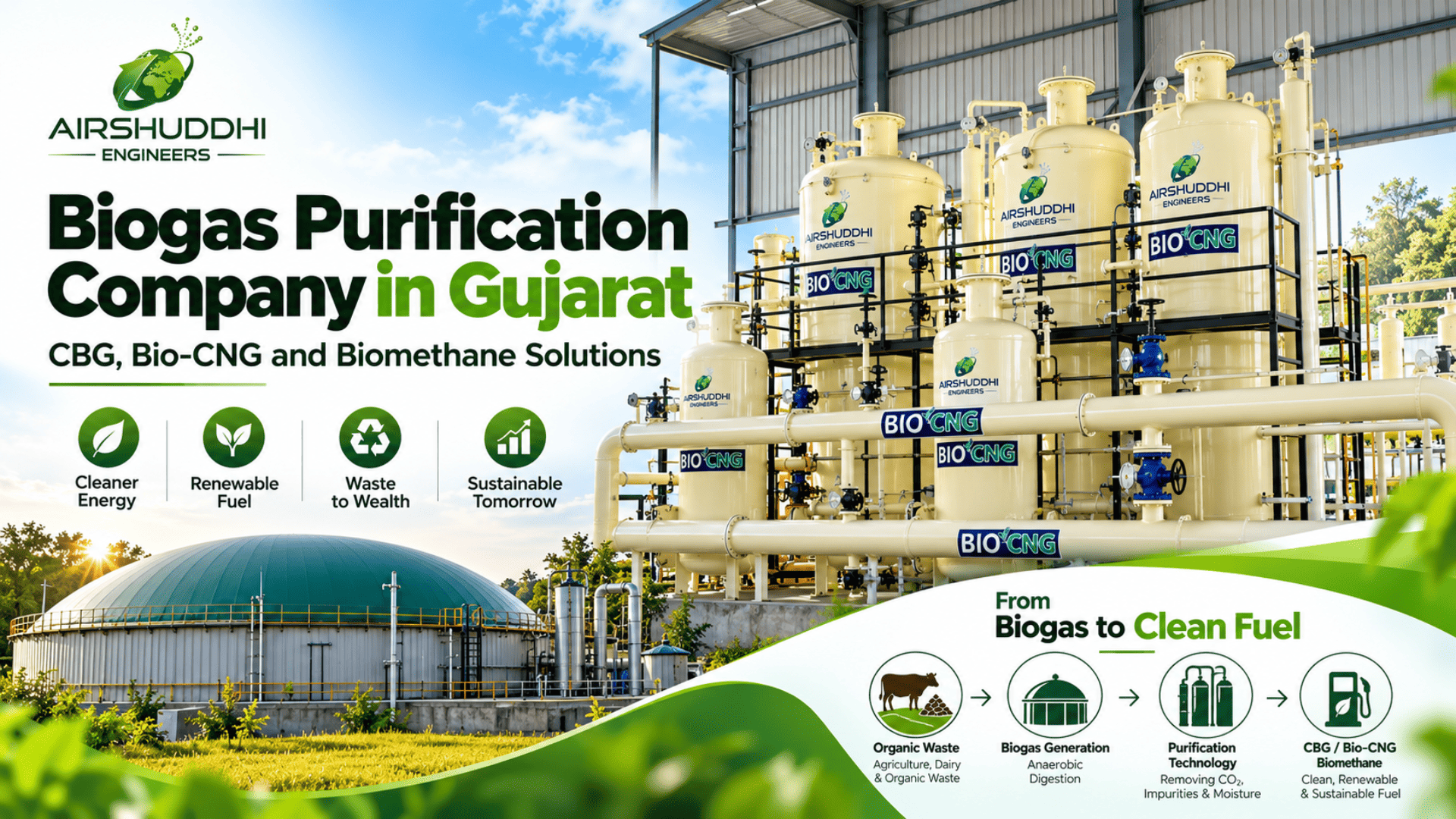
Gujarat's growing industrial, agricultural and dairy sectors create promising opportunities for renewable energy production. Choosing a reliable Biogas Purification Company in Gujarat can help project developers evaluate suitable gas-treatment equipment, improve raw biogas quality and plan for applications such as compressed biogas (CBG), Bio-CNG and biomethane production. With appropriate engineering and project planning, biodegradable waste can become a valuable resource for cleaner energy and more efficient waste management.
Airshuddhi Engineers, based in Ahmedabad, Gujarat, India, provides biogas purification plants, gas-treatment equipment and related industrial solutions. Businesses planning renewable gas projects can benefit from understanding feedstock suitability, purification technologies, equipment integration, operating costs and the requirements of their intended gas application before selecting a technology partner.
Gujarat has diverse agricultural, dairy, food-processing and industrial activities that can generate organic materials suitable for anaerobic digestion. When feedstock is available in sufficient quantities and can be collected economically, it may support biogas production and subsequent gas upgrading.
Potential feedstock sources include:
Dairy and livestock operations: Cattle dung and other suitable biodegradable materials can support anaerobic digestion.
Agricultural enterprises: Selected crop residues and organic agricultural waste may be suitable after assessing their composition and processing requirements.
Food-processing industries: Biodegradable production residues and certain organic wastewater streams may offer opportunities for waste-to-energy projects.
Municipal waste management: Properly segregated organic waste can be considered for biogas generation where collection and contamination controls are effective.
Industrial wastewater treatment: Some biodegradable wastewater streams can generate biogas under appropriate anaerobic treatment conditions.
Every project requires a site-specific assessment. Feedstock availability, seasonal variation, transportation costs, contamination, moisture and digestion performance all influence the amount and quality of gas that can be produced.
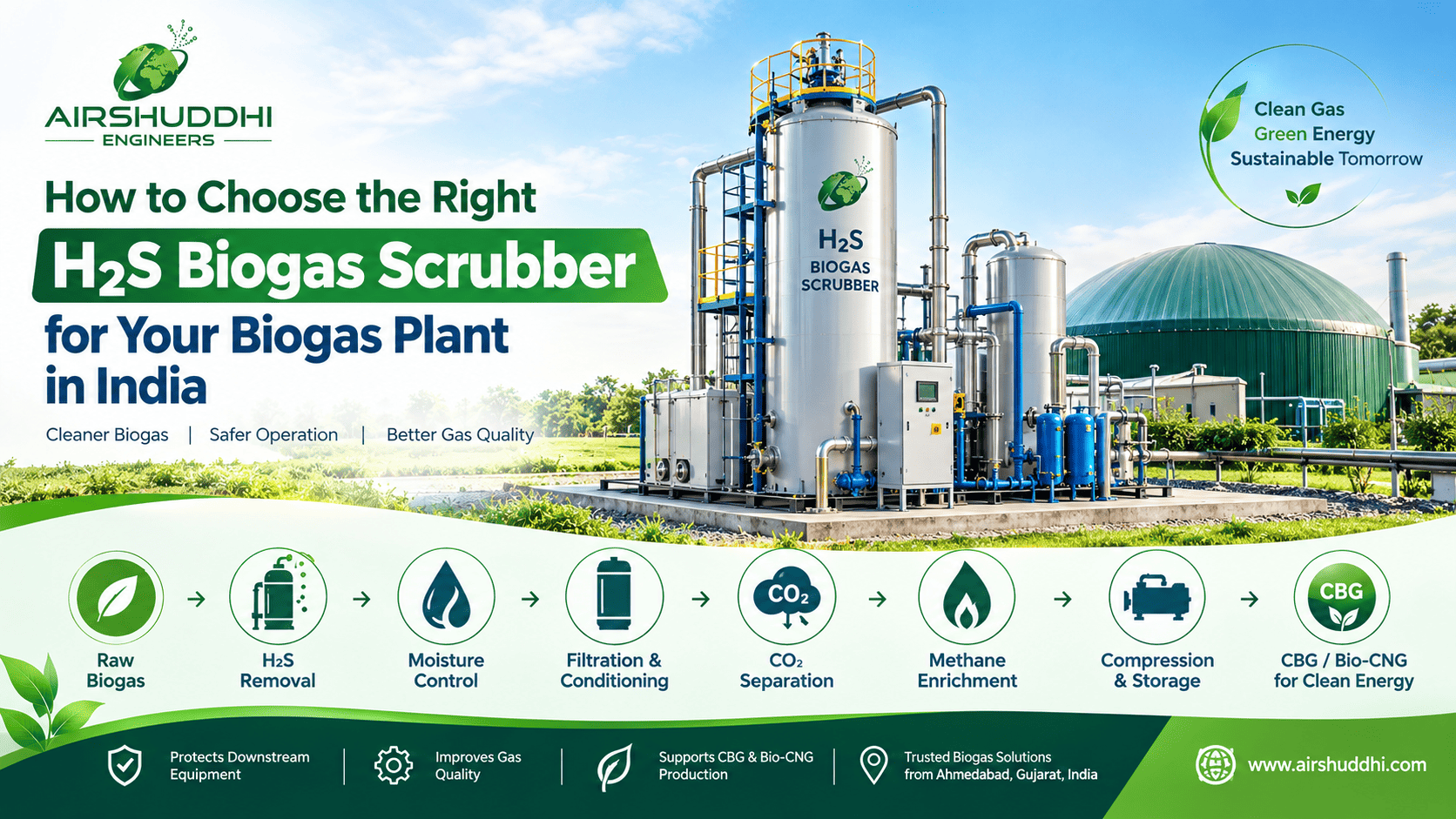
A Biogas Purification Company in Gujarat helps businesses identify and implement suitable equipment for treating raw biogas according to the intended application. Depending on project requirements, the treatment process may involve hydrogen sulphide removal, moisture control, filtration, carbon dioxide separation and methane upgrading.
Raw biogas typically contains methane, carbon dioxide, water vapour and varying quantities of other compounds. These components must be managed according to the requirements of the final application.
A project may involve several interconnected systems:
Raw biogas collection and conditioning
Hydrogen sulphide removal
Moisture separation and filtration
Carbon dioxide removal
Methane enrichment
Gas-quality monitoring
Compression and storage, where required
Integration with downstream equipment
The scope of a supplier should be clearly defined. Buyers should confirm whether the quotation includes the complete treatment system or only selected equipment.
Biogas Purification and Upgrading are closely related processes, but their exact scope can differ.
Purification generally involves reducing unwanted contaminants such as hydrogen sulphide, moisture and other impurities. Upgrading primarily increases methane concentration by separating carbon dioxide and managing other components as necessary.
For CBG and Bio-CNG projects, the treatment configuration must be selected according to the feed gas, target product specifications and downstream equipment requirements.
Important considerations include:
Required methane concentration and gas quality
Inlet H₂S and carbon dioxide levels
Expected gas flow and production variations
Methane recovery and potential gas losses
Energy consumption and operating costs
Compatibility with compression and storage equipment
The objective is not simply to produce methane-rich gas. The system should also achieve appropriate gas quality, reliable operation and commercially practical performance.
The selection of Advanced Biogas Purification Technology in India depends on plant capacity, gas composition, local operating conditions and the required product specifications. Different technologies have different advantages and limitations, so the most appropriate choice should be determined through technical evaluation.
Membrane technology separates gases based on differences in their permeation through specially designed membranes. It can be used to separate carbon dioxide from methane under suitable operating conditions.
When evaluating a membrane-based system, buyers should consider:
Feed-gas pretreatment requirements
Required operating pressure
Methane recovery
Energy consumption
Membrane performance and service life
Required product gas quality
Membrane systems may be suitable for projects seeking a modular approach to biogas upgrading, provided the incoming gas meets the technology's requirements.
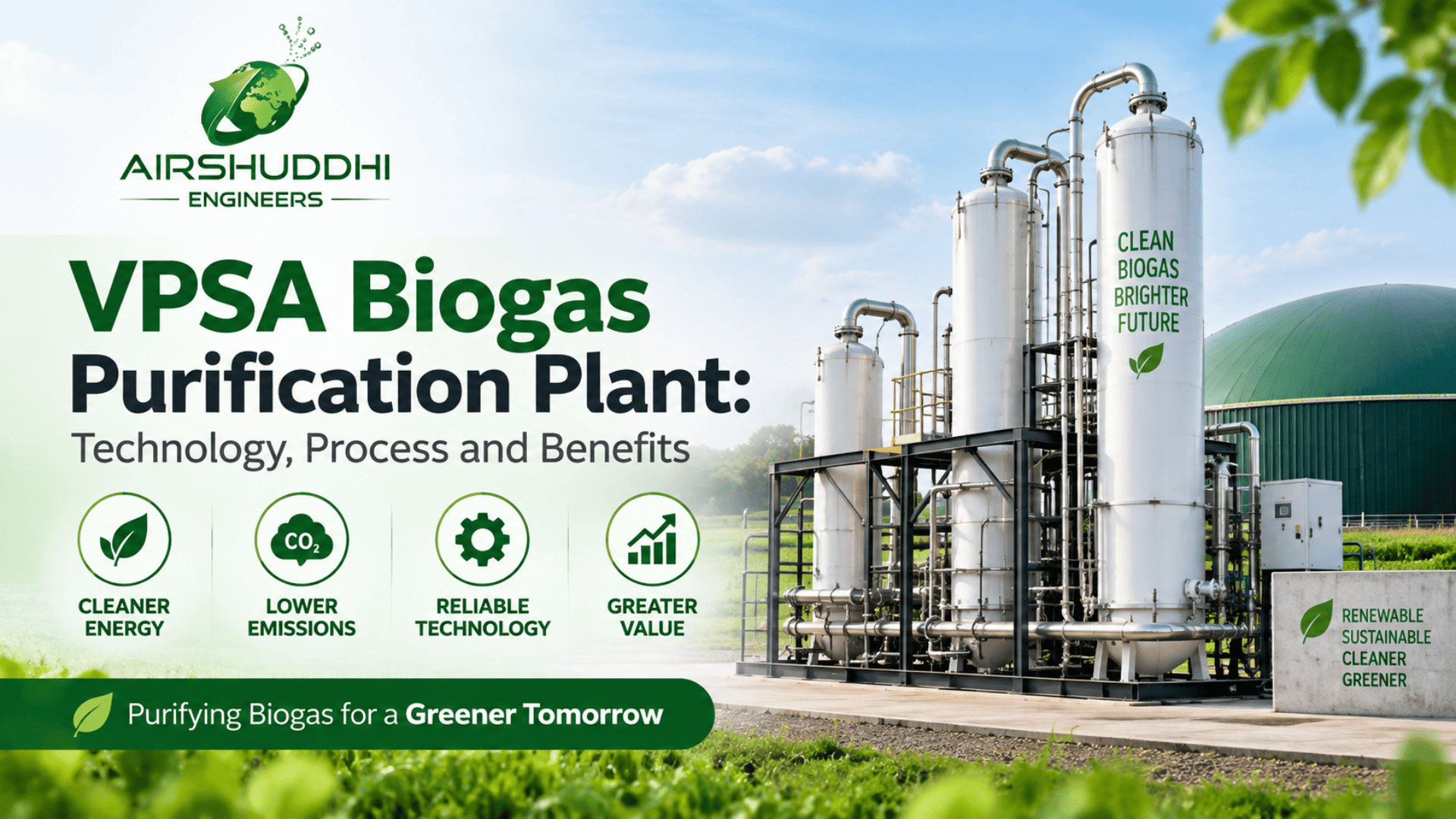
A VPSA Biogas Purification Plant uses vacuum pressure swing adsorption principles to separate selected gas components through adsorption materials and controlled pressure cycles.
The suitability of VPSA depends on the gas composition, plant capacity, process configuration and required performance. Buyers should request information about energy consumption, operating parameters, maintenance and expected methane recovery.
The technology should be compared with other suitable upgrading options rather than selected solely on the basis of its name or advertised capacity.
Pressure swing adsorption uses adsorption materials and pressure cycles to separate gases selectively. The suitability of a PSA configuration depends on the particular gas mixture and separation objective.
For biogas upgrading, buyers should confirm that the proposed process is designed specifically for the intended biogas application.
PSA technology is also used in other industrial gas applications, including nitrogen generation. A PSA Nitrogen Gas Plant Manufacturer serves a different gas-production requirement from a biogas upgrading supplier, although some companies may offer equipment for both application areas.
Biogas Upgrading Water Scrubbing in India is another technology option for suitable biogas projects. It uses the different solubility characteristics of gas components in water to support carbon dioxide separation.
Before choosing water scrubbing, assess water availability, operating pressure, energy requirements, water management, methane losses and the treatment needed for the incoming gas.
A project-specific comparison should consider the complete operating system rather than only the main separation equipment.
Choosing a Biogas Purifier Manufacturer in Gujarat requires an assessment of the supplier's equipment portfolio, engineering capabilities and understanding of your project requirements.
Use the following checklist when evaluating suppliers:
Gas analysis: Confirm whether the supplier requests information about inlet methane, carbon dioxide, H₂S and moisture.
Treatment capacity: Check whether the proposed system can handle normal and peak gas flow.
Product quality: Establish the required outlet gas specifications before equipment selection.
Technology suitability: Compare available systems based on gas composition, efficiency, energy use and operating conditions.
Project integration: Check compatibility with digesters, gas holders, compressors, storage systems and downstream equipment.
Maintenance planning: Understand inspection requirements, consumables, replacement intervals and technical support.
Performance documentation: Request clearly defined design parameters and applicable performance guarantees.
Lifecycle cost: Compare installation, electricity, consumables, maintenance and expected downtime.
Businesses searching for a Biogas Purification Plant Manufacturer should also clarify installation responsibilities, commissioning arrangements, operator training and after-sales service.
Selecting a Biogas Upgradation Plant Manufacturer In India can be an important step for companies developing CBG and biomethane projects. However, supplier selection should be based on project-specific engineering rather than broad promotional claims.
Before finalising a supplier, determine:
Whether the technology is appropriate for the raw biogas composition.
Whether the design meets the intended gas-quality requirements.
Whether the system provides a suitable balance between methane recovery and energy consumption.
Whether the supplier explains operating costs and maintenance requirements.
Whether the equipment can integrate with planned compression, storage and utilisation systems.
For Gujarat-based businesses, working with a supplier located in Ahmedabad may make technical discussions and coordination more convenient. Nevertheless, buyers should evaluate engineering suitability, documentation and service arrangements rather than relying on location alone.
Biogas projects may require supporting equipment beyond the main purification system. Depending on the plant design, these components can help manage gas conditioning, pressure, storage and downstream operation.
Gas holders and storage systems help manage differences between gas generation and consumption. Biogas Storage Tank Manufacturers and Suppliers in India may offer different equipment configurations, but the appropriate design depends on pressure, volume, gas composition, operating conditions and applicable safety requirements.
Buyers should distinguish between low-pressure biogas storage, membrane gas holders and pressure-rated vessels because they serve different functions and require different engineering considerations.
An Air Dryers and Pressure Vessels Manufacturer may supply equipment used in compressed-air systems and other industrial gas applications. For a biogas installation, any dryer or pressure vessel must be suitable for the actual gas composition, pressure, temperature and intended duty.
Standard compressed-air equipment should not automatically be assumed suitable for raw biogas or biomethane service.
A Best Carbon Molecular Sieve Manufacturer India search may be relevant when sourcing materials for selected gas-separation applications, particularly nitrogen generation.
Carbon molecular sieves used in PSA nitrogen systems should not be assumed interchangeable with adsorbents designed for biogas upgrading. Buyers must verify the material's suitability for the specific separation process.
These distinctions help project developers avoid selecting equipment based on a similar product name rather than actual process compatibility.
Businesses searching online for a Top Biogas Purification Plant near me or the Best Biogas Purifier near me should compare suppliers on measurable technical and commercial criteria.
For Gujarat-based projects, evaluate:
Whether the supplier understands the proposed application
Whether the equipment capacity matches expected gas production
Whether the technology supports the required gas-quality target
Whether installation and commissioning support are available
Whether consumables and spare parts can be sourced
Whether the proposal clearly defines the supplier's scope
Whether lifecycle costs are explained transparently
Search phrases such as Biogas Upgradation Plant Manufacturer In India, Biogas Purifier Manufacturer in Gujarat and H2S Biogas Scrubber Manufacturer can help identify relevant suppliers, but search rankings alone do not establish product quality or technical suitability.
Airshuddhi Engineers is based in Ahmedabad, Gujarat, and offers biogas purification and gas-treatment products. Businesses should review the relevant product specifications and discuss their requirements directly with the company.
Airshuddhi Engineers, located in Ahmedabad, Gujarat, India, provides equipment for biogas purification, gas separation and industrial gas applications.
Its published product portfolio includes:
Biogas Purification Plants
VPSA Biogas Purification Plants
PSA Biogas Purification Plants
H₂S Biogas Scrubbers
Membrane Biogas Separation Technology
CNG Booster Compressors
Double Membrane Biogas Balloons
Air Dryers and Pressure Vessels
Carbon Molecular Sieve and related gas-treatment products
The appropriate product depends on the intended process. For example, an H₂S scrubber addresses hydrogen sulphide removal, while a biogas upgrading system may also separate carbon dioxide to increase methane concentration.
Project developers should provide the company with available gas-analysis results, estimated gas flow, required product specifications and intended application to help establish a relevant technical discussion.
Visit Airshuddhi Engineers to explore its gas-treatment and biogas purification portfolio.
Modern renewable gas projects increasingly consider the full production and utilisation chain. The following priorities can influence long-term performance.
Methane recovery measures how much of the methane entering the upgrading process is retained in the useful product gas. It should be evaluated alongside product purity, energy consumption and the management of off-gas streams.
Suitable sensors and control systems can help operators monitor gas composition, pressure, flow and other important parameters. The level of automation should match plant size, process complexity and operational needs.
Converting suitable organic waste into biogas can support renewable energy production and resource recovery. Reliable feedstock collection, digestion performance and responsible digestate management remain essential to achieving practical project outcomes.
Developers should evaluate potential buyers, transportation arrangements, compression needs, applicable gas specifications and relevant approvals before committing to a project. Expected revenues and government incentives should be verified against current requirements and actual commercial arrangements.
Gujarat offers opportunities for biogas, CBG, Bio-CNG and biomethane projects across suitable dairy, agricultural, industrial and waste-management applications. Selecting the right equipment requires a clear understanding of feedstock availability, gas composition, purification technology, methane recovery, operating costs and the final use of the gas.
A reliable Biogas Purification Company in Gujarat should help buyers assess these requirements and identify equipment suited to the project's operating conditions. Rather than selecting a system solely by price or promotional claims, compare technical specifications, lifecycle costs, maintenance arrangements and system integration.
Airshuddhi Engineers, based in Ahmedabad, Gujarat, provides biogas purification plants, H₂S scrubbers, membrane separation technology and related gas-treatment equipment. Businesses planning a renewable gas project can explore its product portfolio and discuss their specific technical requirements.
A biogas purification company provides equipment and technical solutions for treating raw biogas. Depending on the project, these may include H₂S removal, moisture control, filtration, carbon dioxide separation and methane upgrading.
Compare the supplier's product portfolio, engineering capabilities, design capacity, gas-quality specifications, lifecycle costs, documentation, maintenance arrangements and technical support.
Potential options include membrane separation, PSA, VPSA, water scrubbing and other suitable gas-separation processes. Selection depends on feed-gas composition, plant capacity, methane recovery, energy requirements and the required product quality.
A VPSA system uses adsorption materials and controlled vacuum-pressure cycles to separate selected gas components. Its suitability depends on the feed-gas characteristics, system design and intended application.
No. Water scrubbing suitability depends on gas composition, required outlet quality, water availability, energy use, methane losses and operating costs. It should be compared with other suitable technologies before selection.
An H₂S biogas scrubber reduces hydrogen sulphide in raw biogas. This can help control corrosion risks and prepare the gas for downstream equipment, subject to the system's design and operating conditions.
Not automatically. Adsorbents are designed for particular separation processes. Buyers should confirm material specifications and suitability with the equipment and process supplier.
Depending on the process, a project may require gas holders, moisture separation, filtration, purification equipment, compressors, storage systems, instrumentation and safety devices. The exact configuration depends on the plant design and final application.
Review technology suitability, treatment capacity, gas-quality guarantees, methane recovery, energy consumption, operating costs, equipment integration, safety measures and after-sales support.
Airshuddhi Engineers is based in Ahmedabad, Gujarat, and lists biogas purification plants, H₂S scrubbers, membrane separation technology and related gas-treatment equipment on its website. Contact the company to discuss your project-specific requirements.