Call Us

-
-
-
Office Address
401 & 402, Smart Walls, Nr Science City Circle, SP Ring Road, Ahmedabad-380060, Gujarat (INDIA)
Office Address

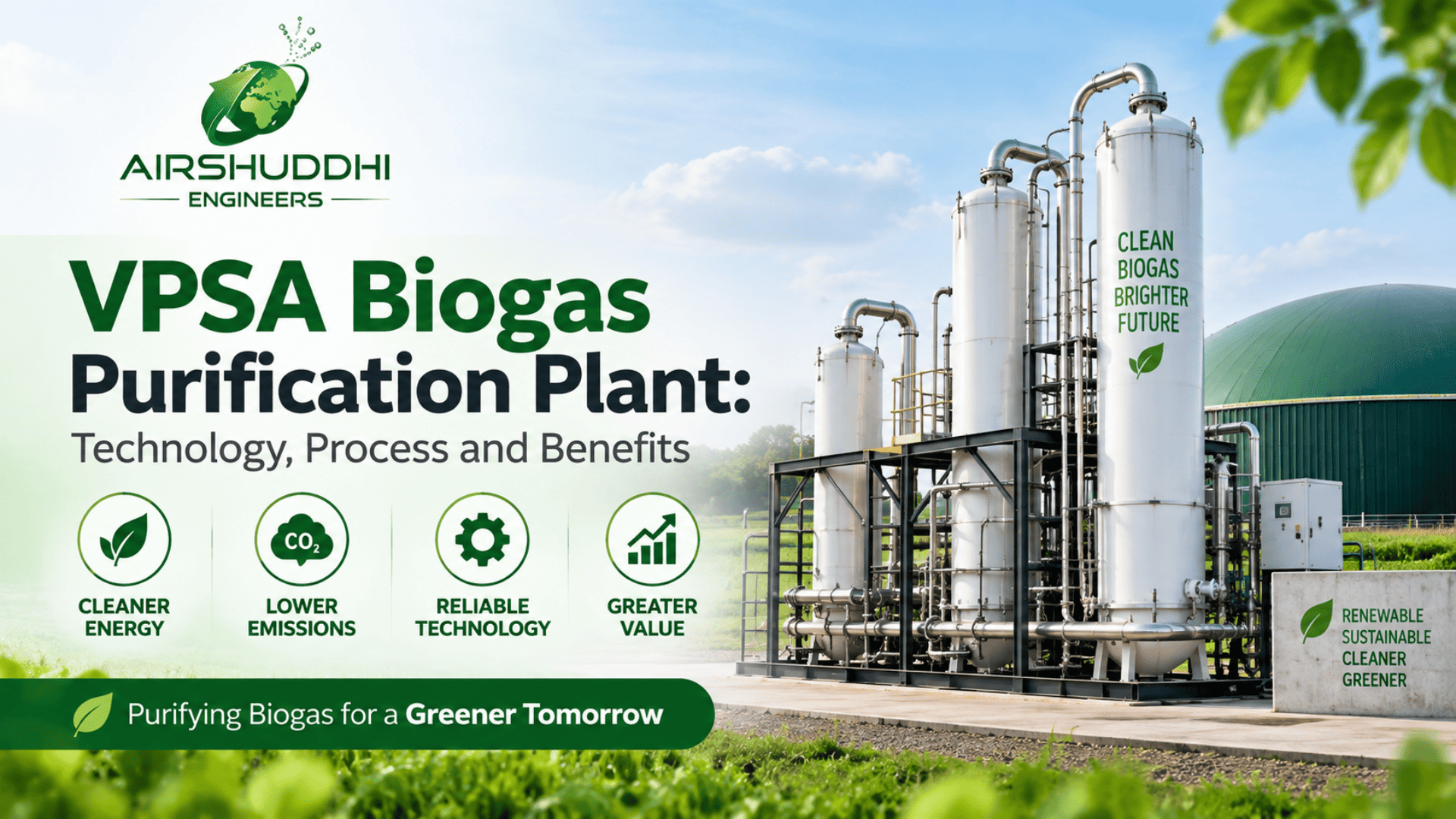
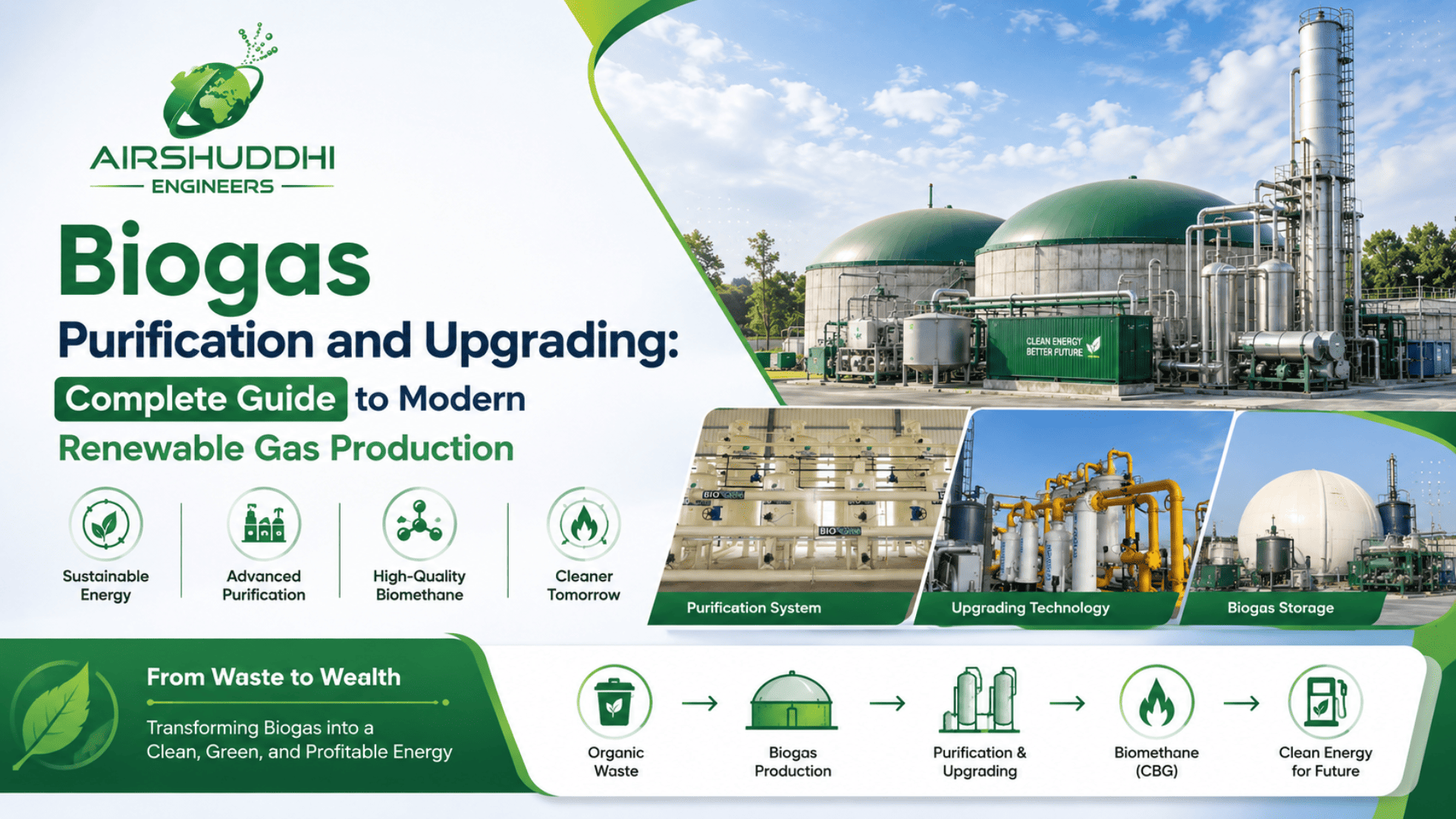
A Biogas Purification Plant is an important part of converting raw biogas into a cleaner, methane-rich gas suitable for applications such as CBG, Bio-CNG, biomethane, industrial fuel, and other renewable-energy uses. Raw biogas generated through anaerobic digestion contains methane along with carbon dioxide, hydrogen sulfide, water vapour, and other trace contaminants. The purification process removes or reduces these unwanted components so that the methane can be utilized more effectively.
According to the U.S. EPA, biogas commonly contains methane, carbon dioxide, hydrogen sulfide and water vapour, while upgrading involves removing water, CO₂, H₂S and other impurities to produce a higher-quality renewable gas.
But how exactly does a Biogas Purification Plant work?
The answer is not simply one filtration stage. A modern plant normally uses several interconnected treatment stages, with each stage performing a specific function. Depending on the feedstock, gas composition, capacity and final application, the system may incorporate H₂S scrubbing, moisture removal, CO₂ separation, adsorption, membrane separation, water scrubbing, PSA or VPSA technology, followed by compression and gas-quality monitoring.
This step-by-step guide explains the complete process in practical terms.
A Biogas Purification Plant is an engineered gas-treatment system designed to clean and upgrade raw biogas.
The main objective is to separate unwanted components while retaining as much useful methane as possible.
A typical raw biogas stream can contain:
The exact composition changes according to the source of organic material and operating conditions.
For a CBG or biomethane project, purification becomes particularly important because the final gas needs to meet the quality requirements of its intended application. EPA guidance also identifies moisture, H₂S and CO₂ removal as important treatment stages for upgraded renewable gas.
The process starts with anaerobic digestion.
Organic materials such as agricultural residues, cattle dung, food waste, wastewater-related organic matter and other biodegradable feedstocks can be processed in an oxygen-free environment. Microorganisms break down the organic material and generate biogas.
The produced gas is collected from the digester and transferred through a controlled gas-handling system.
At this stage, the gas is still considered raw biogas and may contain substantial amounts of CO₂, H₂S and moisture.
Therefore, it is generally not sent directly into the final fuel or compression system.
The collected gas first enters the gas-handling and conditioning section.
This stage is important because purification equipment works best when the incoming gas is properly conditioned.
Typical equipment may include:
The purpose is to stabilize the gas flow and remove bulk moisture or particulate matter before deeper purification.
Temporary gas storage can also help balance variations between biogas production and downstream gas demand. EPA guidance notes that temporary biogas storage may be used to balance production and utilization requirements.
One of the most important early treatment stages is H₂S removal.
Hydrogen sulfide is undesirable because it can contribute to corrosion and create problems for downstream equipment.
A dedicated H2S Scrubber System Manufacturer can provide gas-treatment systems designed around the H₂S concentration and project requirements.
Depending on the application, H₂S can be reduced through different treatment approaches, including:
EPA technical guidance identifies adsorption, biological scrubbing and chemical scrubbing among the available H₂S treatment approaches.
For higher-capacity systems, the H₂S treatment stage may become an important protection barrier before the gas enters the main upgrading equipment.
Raw biogas normally contains water vapour because the gas is generated from wet biological processes.
Excess moisture can create operational problems in pipelines, compressors, separation systems and downstream equipment.
Therefore, moisture control is another important part of the purification process.
A plant may use:
This is where equipment from a PSA Air Dryer Manufacturer can become relevant for certain compressed-gas applications and supporting systems.
Proper dehydration also helps protect equipment and maintain stable gas-treatment performance.
After initial H₂S and moisture treatment, the gas may pass through additional filtration.
The objective is to protect the main purification equipment from contaminants that could affect separation performance.
Depending on the feedstock and process design, additional treatment may be considered for:
The exact filtration arrangement should be based on laboratory analysis of the raw biogas rather than using an identical configuration for every project.
This is one reason why Biogas Purification Equipment must be selected according to actual gas conditions.
Once the gas has been properly conditioned, the main upgrading stage can begin.
The major objective at this point is to reduce CO₂ concentration and increase the relative concentration of methane.
Several technologies can be used for CO₂ separation.
Pressure Swing Adsorption uses adsorption media inside pressurized vessels.
The gas passes through the adsorbent, which preferentially retains selected components. When the adsorbent becomes loaded, the pressure is reduced to regenerate the material.
EPA guidance describes PSA as one established option for CO₂ removal from biogas.
A Best VPSA Biogas Purification System uses both pressure and vacuum cycles.
The basic principle involves controlling adsorption and regeneration conditions to separate unwanted components from the methane-rich gas stream.
VPSA systems may be evaluated where project developers are looking at:
The actual configuration depends on the raw-gas composition and required outlet specification.
Membrane technology uses selective membranes that allow different gases to pass through at different rates.
Airshuddhi Engineers currently lists Membrane Biogas Separation Technology and a biogas purification plant application among its solutions.
Membrane systems can be useful for projects where modularity, continuous separation and compact system design are important considerations.
A Water Scrubber Manufacturer can provide systems using water to separate certain components from biogas based on differences in solubility.
A CO2 Removal Water Scrubber may therefore be considered for suitable applications where water-based gas upgrading is technically and economically appropriate.
EPA documentation identifies spray towers/wash systems among technologies that can remove CO₂ and H₂S from biogas.
After the main separation stage, the treated gas becomes significantly richer in methane.
The exact gas quality depends on:
This stage is especially important because the objective is not merely to remove CO₂.
A well-engineered system must also aim to minimize unnecessary methane losses.
For renewable-gas projects, methane recovery is therefore an important performance consideration alongside gas purity.
Depending on the final application, an additional polishing stage may be included.
The purpose is to bring the gas quality within the required operating specification before compression, storage, transportation or utilization.
Final treatment may include:
The required specification should always be determined by the intended end use and applicable project requirements.
Modern purification plants require more than mechanical equipment.
Instrumentation and automation help operators understand what is happening inside the system.
Typical monitoring parameters can include:
Gas analyzers, sensors, PLC controls and automated valves can help maintain consistent operating conditions.
This is increasingly important as Advanced Biogas Purification Technology in India moves toward more automated and data-driven plant operation.
Once the gas has reached the required quality, it can move toward its final application.
Depending on the project, this may include:
Compression may be required for transportation, storage or fuel applications.
Airshuddhi Engineers also lists CNG Booster Compressor and Double Membrane Biogas Balloon solutions as part of its product portfolio.
A Double Membrane Biogas Balloon Manufacturer can provide gas-storage systems that help manage variations in gas production and demand.
A Biogas Balloon Supplier in India can therefore be relevant where intermediate or temporary biogas storage is required.
The complete process can be understood through this simplified sequence:
Organic Waste
↓
Anaerobic Digestion
↓
Raw Biogas Generation
↓
Gas Collection & Conditioning
↓
Moisture / Condensate Removal
↓
H₂S Scrubbing
↓
Fine Filtration
↓
CO₂ Separation
↓
PSA / VPSA / Membrane / Water Scrubbing
↓
Methane-Rich Gas
↓
Final Gas Polishing
↓
Gas Quality Monitoring
↓
Compression & Storage
↓
CBG / Bio-CNG / Biomethane / Industrial Application
The exact sequence can vary according to project design, feedstock, gas composition and final gas specification.
A modern plant may combine several types of equipment.
Important components can include:
Supporting industrial-gas equipment may also be required depending on the overall facility.
Airshuddhi Engineers' product range includes PSA Nitrogen Gas Plants, PSA Oxygen Gas Plants, VPSA Oxygen Gas Plants, Air Dryers & Pressure Vessels and Carbon Molecule Sieve systems.
A company searching for a complete industrial gas solution may encounter related technologies alongside biogas purification.
For example:
A PSA Oxygen Gas Plant Manufacturer supplies oxygen-generation systems based on adsorption technology.
A VPSA Oxygen Plant Manufacturer provides VPSA-based oxygen-generation solutions for suitable industrial applications.
A Nitrogen Gas Plant Manufacturer can provide on-site nitrogen-generation systems for industries requiring controlled nitrogen supply.
Carbon molecular sieve is an important adsorption material in many PSA nitrogen-generation systems. Therefore, a Carbon Molecular Sieve Supplier may be relevant when selecting or replacing adsorption media.
Searches such as Nitrogen Generator Carbon Molecular Sieve India and Top PSA Nitrogen Plant CMS in India are generally associated with nitrogen-generation applications rather than biogas upgrading itself.
A Pressure Vessels Manufacturer India can provide pressure-rated vessels used in different industrial gas systems.
Similarly, an Air Receiver Tank Manufacturer supplies storage vessels used with compressed-air systems.
These products are related to the wider industrial gas-engineering ecosystem, but they should not be confused with the core CO₂-removal section of a biogas upgrading plant.
This distinction is important.
A Biogas Filtration System in India may primarily focus on removing particles, moisture, oil aerosols or selected contaminants.
A complete purification or upgrading plant performs a broader function.
It may include:
Therefore, filtration is often one part of the overall purification chain rather than the complete process.
A purification plant should not be considered an isolated machine.
The complete renewable-gas system may involve:
Each stage affects the next.
Poor pretreatment, for example, can increase the load on downstream purification equipment. Likewise, inadequate moisture control can affect compressors and other gas-handling components.
This integrated approach is particularly important for Biogas Upgradation Plant Manufacturer projects where the purification system must operate continuously with upstream and downstream equipment.
Airshuddhi Engineers, based in Ahmedabad, Gujarat, India, provides gas purification and gas-treatment solutions for industrial and renewable-energy applications.
The company's current product portfolio includes:
Located in Ahmedabad, Gujarat, India, Airshuddhi Engineers works across gas-treatment and industrial gas applications.
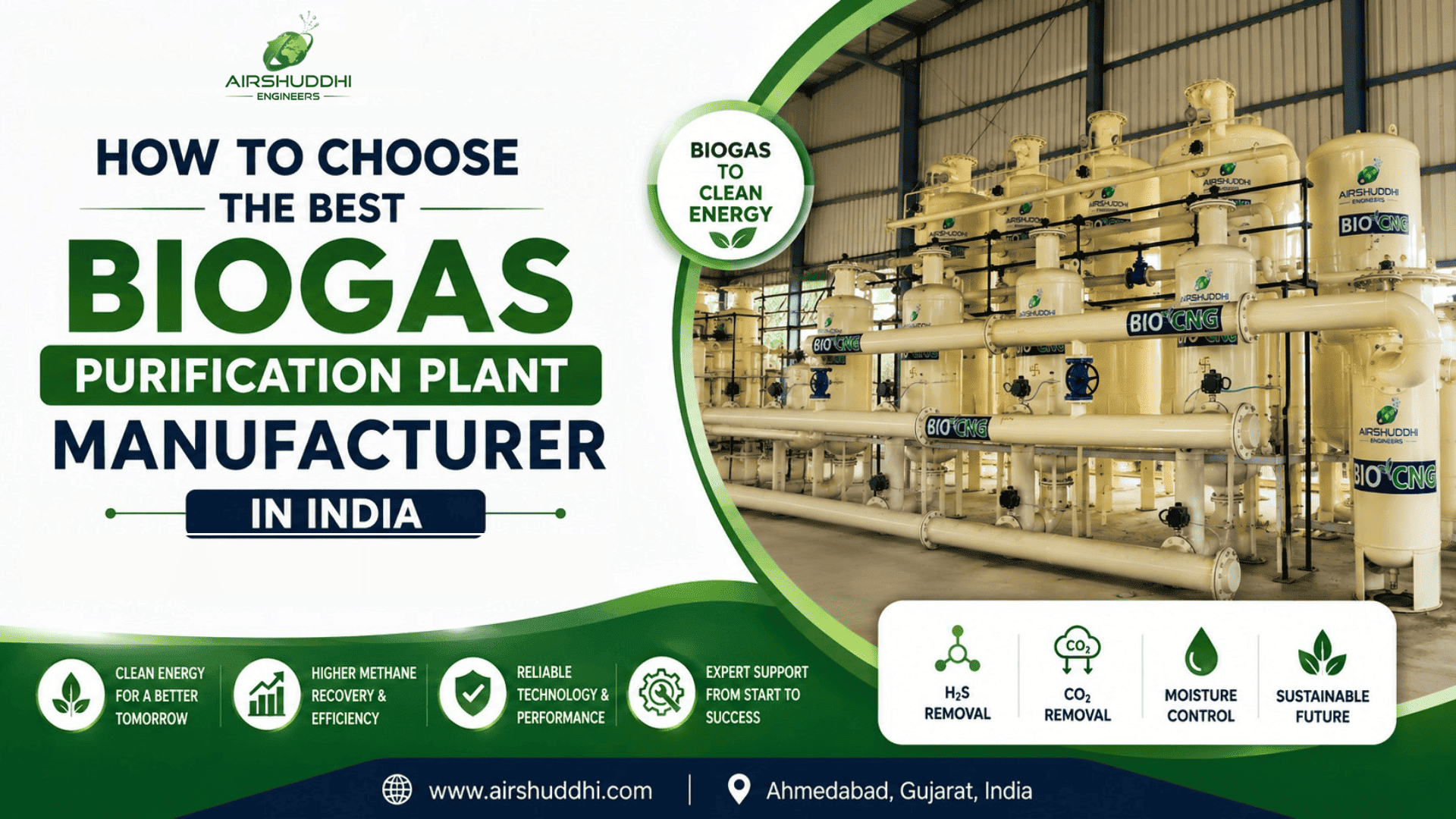
For organizations searching online for a Top Biogas Purification System Manufacturer in India, Top Biogas Purification Company in India, Top Biogas Purification Plant Manufacturer in India, or Best Biogas Purifier near me, the important consideration should be technical suitability rather than simply selecting a supplier based on a search ranking.
The plant should be engineered around the actual gas composition, capacity, final application and operating requirements.
Before installing a purification plant, project developers should evaluate:
This information helps determine whether PSA, VPSA, membrane separation, water scrubbing or another combination of technologies is appropriate.
A Biogas Purification Plant can be designed to remove or reduce unwanted components such as H₂S, CO₂, moisture and other contaminants. The exact treatment stages depend on the raw gas and final application.
H₂S treatment is often important because hydrogen sulfide can contribute to corrosion and damage downstream equipment. The appropriate removal technology depends on concentration, flow rate and the intended use of the gas.
CO₂ has lower fuel value than methane. Reducing CO₂ increases the methane concentration and can make the gas more suitable for upgraded renewable-gas applications.
VPSA biogas purification uses controlled pressure and vacuum cycles with adsorption media to support separation of selected gas components. Its suitability depends on the project's feed gas and required product quality.
Yes. Upgraded biogas can be further processed and compressed for applications such as CBG or Bio-CNG, provided the resulting gas meets the relevant quality and project requirements.
No. Water scrubbing depends on factors such as gas composition, capacity, water availability, treatment requirements and operating economics. Technology selection should be based on a project-specific assessment.
Businesses searching for a Top Biogas Purification Plant near me should compare manufacturers based on technology capability, engineering support, plant integration, equipment quality, commissioning assistance and after-sales service rather than location alone.
A Biogas Purification Plant is a multi-stage gas-treatment system rather than a single filtration machine. The process generally begins with raw biogas collection and conditioning, followed by moisture management, H₂S removal, filtration, CO₂ separation, gas polishing, quality monitoring and finally compression, storage or utilization.
Modern technologies such as PSA, VPSA, membrane separation and water scrubbing provide different approaches to biogas upgrading. The most suitable configuration depends on feedstock, gas composition, plant capacity, required methane concentration, methane recovery, energy consumption and final application.
As India's renewable-gas sector continues to develop, efficient purification and upgrading systems will remain important for converting organic waste into useful methane-rich fuel.
For businesses evaluating Biogas Purification and Upgradation Companies in India, Top Biogas Purification and Bottling Plants in India, or an Advanced Biogas Purification Technology in India, the right starting point is a detailed analysis of the project rather than a generic equipment package.
Airshuddhi Engineers, Ahmedabad, Gujarat, India, offers biogas purification and gas-treatment solutions including PSA, VPSA, H₂S scrubbing and membrane-based technologies.
For more information about Airshuddhi Engineers and its gas purification solutions, visit www.airshuddhi.com.