Call Us

-
-
-
Office Address
401 & 402, Smart Walls, Nr Science City Circle, SP Ring Road, Ahmedabad-380060, Gujarat (INDIA)
Office Address
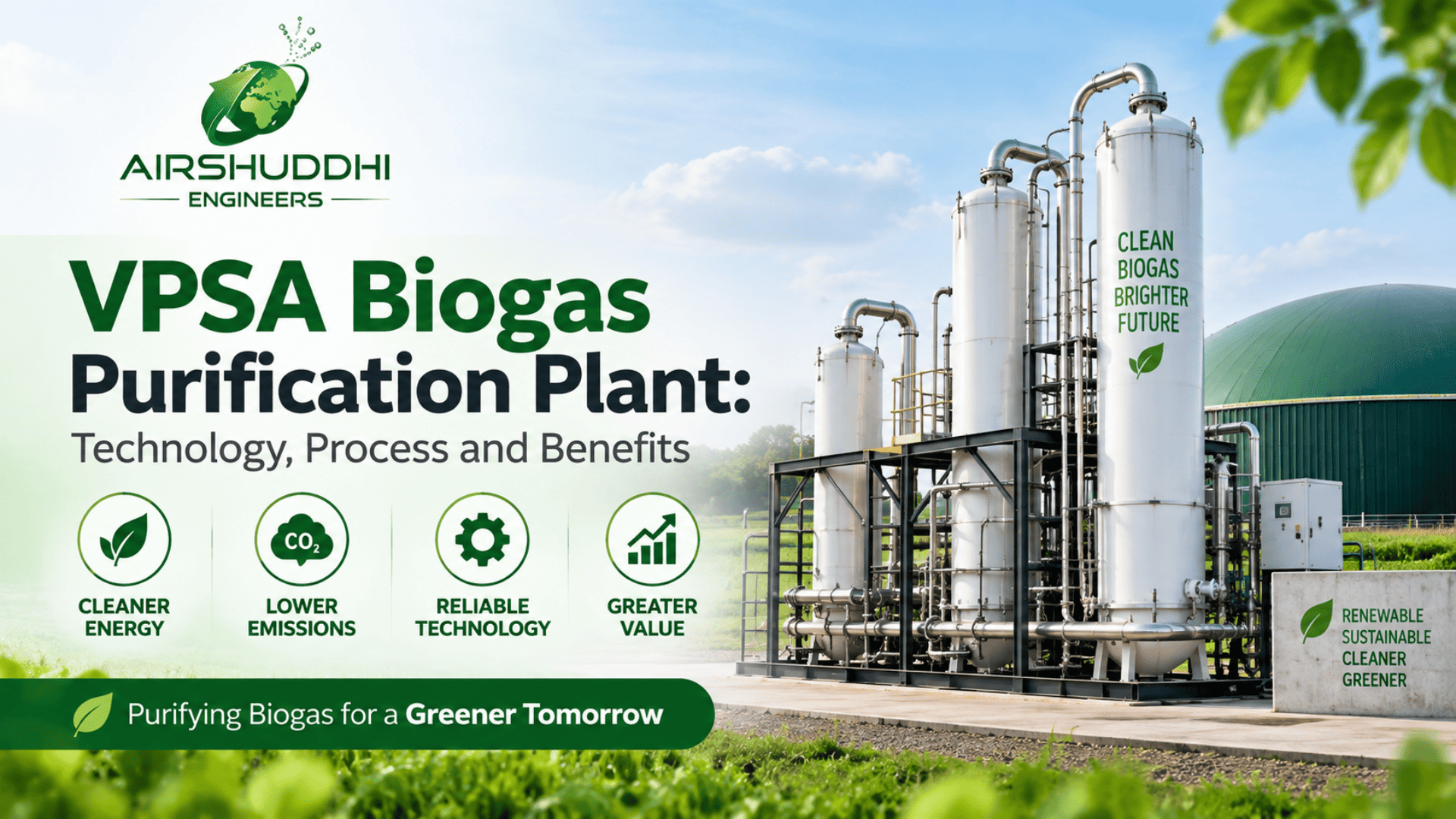
As the renewable-energy sector expands, converting organic waste into a usable methane-rich fuel is becoming increasingly important. A VPSA Biogas Purification Plant uses adsorption-based gas separation technology to reduce carbon dioxide and improve the quality of biogas for applications such as biomethane, Bio-CNG and CBG production.
Unlike conventional gas-cleaning equipment that primarily focuses on removing contaminants, a VPSA system is designed around the controlled separation of gases through pressure and vacuum cycles. This makes VPSA Biogas Upgrading Technology an important option for projects where gas quality, methane recovery, automation and efficient upgrading are major considerations.
For developers planning a renewable-gas project, understanding how VPSA works is essential before selecting a VPSA Biogas Purification System. The actual configuration depends on raw-gas composition, flow rate, pressure, required product quality and final application.
VPSA stands for Vacuum Pressure Swing Adsorption. It is an adsorption-based separation process in which gas components interact differently with a specially selected adsorbent material.
In biogas upgrading, carbon dioxide is preferentially adsorbed while methane passes through as the product gas. Pressure changes and vacuum regeneration are then used to release the adsorbed gases and prepare the adsorbent for another cycle.
Pressure-swing adsorption is a recognized approach for separating CO₂ from methane. EPA documentation describes PSA systems using solid adsorption media in pressurized vessels, followed by regeneration when pressure is reduced. VPSA extends the concept by incorporating vacuum conditions into the regeneration cycle.
A VPSA Biogas Purifier can therefore become a central component of a modern Biogas Upgradation Plant Manufacturer solution, particularly where the objective is to produce methane-rich gas for downstream utilization.
Raw biogas generally contains methane and carbon dioxide along with moisture, hydrogen sulfide and other trace components. To produce biomethane or renewable natural gas, the methane concentration needs to be increased by removing CO₂ and other unwanted components.
This creates a need for reliable gas-upgrading technologies.
A VPSA Biogas Purification Technology solution can be considered when a project requires:
The suitability of VPSA should always be determined from actual feed-gas conditions rather than from a generic technology comparison.
The main concept behind VPSA is the difference in adsorption behavior between gases.
The system normally uses multiple adsorption vessels operating in coordinated cycles. While one vessel is processing incoming gas, another can be undergoing regeneration. This cyclic arrangement allows the plant to maintain a continuous product-gas flow.
A simplified VPSA cycle can be understood through the following stages:
Before entering the adsorption section, the gas should meet the required feed conditions.
Depending on the project, upstream equipment may be used for:
This preparation is important because contaminants can negatively affect adsorption media and downstream equipment. IEA Bioenergy notes that adsorption-based upgrading requires appropriately treated feed gas, including control of hydrogen sulfide and moisture.
The conditioned gas enters an adsorption vessel containing a selective adsorbent.
Under suitable pressure conditions, CO₂ has a stronger affinity for the adsorbent than methane. As the gas passes through the vessel, the adsorbent retains the targeted component while methane-rich gas continues toward the product outlet.
This is the heart of the VPSA CO2 Removal System.
As CO₂ is retained inside the adsorption vessel, the remaining gas becomes richer in methane.
The resulting product stream can be directed toward downstream equipment depending on the project design.
Potential applications include:
Biogas upgrading increases the methane concentration by removing CO₂ and other impurities, allowing the upgraded gas to be used in applications requiring higher-quality methane.
Once an adsorption vessel reaches its operating limit, its pressure is reduced.
This causes the adsorbed gases to desorb from the material.
The VPSA process introduces a vacuum phase to assist regeneration.
Under reduced pressure, the adsorbent releases the previously captured CO₂ and other separated components. The vessel can then be prepared for another adsorption cycle.
The use of multiple vessels makes it possible to coordinate adsorption, depressurization, regeneration and repressurization while maintaining relatively continuous processing.
After regeneration, the vessel returns to adsorption service.
The vessels operate in sequence rather than all performing the same function at the same moment. This cyclic arrangement is fundamental to VPSA Biogas Upgrading Technology.
A complete system may include several interconnected components rather than a single purification machine.
Typical equipment can include:
The exact equipment configuration should be engineered according to the raw biogas characteristics and required product specification.
Producing methane-rich gas is only one part of successful biogas upgrading. Methane recovery is equally important.
If methane is lost with the separated gas stream, the overall resource efficiency of the plant can decline. Therefore, a modern VPSA Methane Recovery System should be designed with appropriate cycle control, gas routing and recovery strategies.
IEA Bioenergy highlights methane recovery and minimizing methane emissions as important considerations when evaluating biogas upgrading technologies.
Actual recovery depends on:
Therefore, published performance figures should not automatically be treated as guaranteed results for every project.
A properly engineered VPSA Biogas Purification Plant can offer several potential advantages for renewable-gas projects.
VPSA is specifically suited to adsorption-based separation of CO₂ from methane-rich gas.
Multiple vessels can operate in coordinated cycles, supporting continuous gas upgrading.
Modern systems can use automated valves, sensors, programmable controls and process monitoring to coordinate adsorption and regeneration cycles.
Removing a substantial portion of CO₂ increases the methane concentration and improves the usability of the gas.
VPSA can be evaluated for applications involving biomethane, CBG and Bio-CNG production.
A VPSA system can be engineered as part of a broader gas-treatment and compression arrangement.
The appropriate configuration can be developed according to feed-gas flow, product requirements and project objectives.
These benefits are dependent on engineering design, feed-gas quality, equipment selection and operating conditions. IEA Bioenergy notes that technology selection for biogas upgrading should be based on site-specific considerations.
One of the major opportunities for a VPSA Biomethane Plant is the conversion of biogas into a higher-quality renewable gas.
The upgraded methane-rich gas can be further processed according to the requirements of the intended application.
Biogas upgrading can produce biomethane with characteristics suitable for applications that require higher methane concentration.
For transportation-fuel projects, upgraded biogas can be compressed and prepared according to applicable gas-quality requirements.
A CBG Biogas Purification Plant can form part of a larger compressed-biogas project where raw biogas is upgraded before compression, storage and distribution.
The final gas specification must always be established according to the intended application and applicable standards.
VPSA is one of several technologies available for biogas upgrading.
Common approaches include:
IEA Bioenergy identifies pressure swing adsorption, membrane separation and scrubbing/absorption among established biogas-upgrading approaches and emphasizes that technology suitability depends on project-specific conditions.
Therefore, searching for the Best VPSA Biogas Purification System in India should not mean selecting a system based only on marketing claims. The better approach is to evaluate feed-gas characteristics, required gas quality, energy requirements, methane recovery, automation, maintenance and lifecycle economics.
The technology can be evaluated for several renewable-energy and waste-to-energy applications, including:
The underlying principle is to transform biogas into a more usable methane-rich gas stream through controlled gas separation.
Airshuddhi Engineers, based in Ahmedabad, Gujarat, India, provides gas purification and gas-treatment solutions for renewable-energy and industrial applications.
Its current portfolio includes a VPSA Biogas Purification Plant, Biogas Purification Plant, PSA Biogas Purification Plant, H₂S Biogas Scrubber, Membrane Biogas Separation Technology, CNG Booster Compressor, Double Membrane Biogas Balloon, PSA Oxygen Gas Plant, VPSA Oxygen Gas Plant, Nitrogen Gas Plant, Air Dryers & Pressure Vessels and Carbon Molecular Sieve.
For organizations researching a VPSA Biogas Upgrading Plant Manufacturer, the project should begin with an assessment of the available biogas and the desired end use.
Important project information includes:
This information allows the engineering team to determine the appropriate configuration rather than applying the same equipment arrangement to every project.
Airshuddhi Engineers also works across associated gas-treatment and industrial-gas equipment categories.
Its portfolio includes solutions related to:
These systems belong to different gas-processing applications and should not be confused with the core VPSA biogas-upgrading process. Airshuddhi's website identifies these as separate product categories within its broader gas-treatment portfolio.
Before selecting a supplier, project developers should consider more than the initial equipment quotation.
A technical evaluation can include:
This approach is especially important when searching for a VPSA Biogas Purification Plant Manufacturer in India, VPSA Biogas Purification Plant Manufacturer in Ahmedabad, or VPSA Biogas Upgradation Plant Manufacturer in India.
A VPSA Biogas Purification Plant provides an adsorption-based approach to upgrading biogas by using coordinated pressure and vacuum cycles for gas separation. Its primary purpose is to improve methane concentration by separating CO₂ and preparing the gas for higher-value applications.
The technology can be relevant to VPSA Biomethane Plants, Bio-CNG projects, CBG facilities and renewable-gas applications, provided the plant is correctly designed around the feed-gas characteristics and required product specification.
For companies looking for a VPSA Biogas Purification Company in India, VPSA Biogas Purification Company in Gujarat, or a VPSA Biogas Purifier near me, technical suitability should remain the starting point. Feed-gas quality, methane recovery, CO₂ removal, energy consumption, automation and long-term operation all influence the success of a project.
Based in Ahmedabad, Gujarat, India, Airshuddhi Engineers offers solutions covering biogas purification, VPSA technology, PSA systems, H₂S scrubbing, membrane separation and associated gas-treatment equipment. Its current website specifically lists a VPSA Biogas Purification Plant among its renewable-gas solutions.
For renewable-energy developers exploring Advanced Biogas Purification Technology in India, VPSA can be an important technology to evaluate as part of a properly engineered biogas-to-biomethane or CBG project.
A VPSA Biogas Purification Plant uses Vacuum Pressure Swing Adsorption to separate CO₂ from methane-rich biogas through controlled adsorption, depressurization and vacuum regeneration cycles. Unlike basic biogas cleaning systems that primarily remove contaminants such as H₂S or moisture, VPSA is focused on biogas upgrading and CO₂ separation to increase methane concentration. The most suitable upgrading technology depends on feed-gas composition, required product quality, plant capacity and project conditions.
Raw biogas normally requires suitable conditioning before entering the VPSA adsorption section. Depending on the gas composition, pretreatment may include H₂S removal, moisture and condensate removal, particulate filtration and other contaminant-control stages. Proper pretreatment helps protect the adsorption media and downstream equipment while supporting stable operation of the upgrading system. The exact pretreatment arrangement should be selected after analyzing the raw biogas.
Yes. A VPSA Biogas Upgradation Plant can be integrated into projects where biogas is upgraded into a methane-rich gas stream for applications such as biomethane, Bio-CNG and CBG. After upgrading, additional compression, drying, polishing, storage and gas-quality controls may be required depending on the intended application and applicable specifications.
Project developers should evaluate more than the equipment price when selecting a VPSA Biogas Upgrading Plant Manufacturer in India. Important considerations include raw biogas flow rate, methane and CO₂ concentration, H₂S and moisture levels, required product-gas quality, methane recovery, energy consumption, automation, equipment reliability, maintenance requirements and after-sales support. Technology selection should be based on site-specific project requirements rather than a single standard configuration.
VPSA Biogas Purification Technology provides an adsorption-based method for CO₂ removal and methane enrichment. Potential benefits include controlled cyclic operation, automated gas separation, methane-rich product gas and integration with downstream biomethane or CBG systems. The overall performance of a VPSA plant depends on feed-gas quality, system design, adsorbent characteristics, operating conditions and methane-loss management. Minimizing methane losses from upgrading systems is also an important consideration for renewable-gas projects.