Call Us

-
-
-
Office Address
401 & 402, Smart Walls, Nr Science City Circle, SP Ring Road, Ahmedabad-380060, Gujarat (INDIA)
Office Address
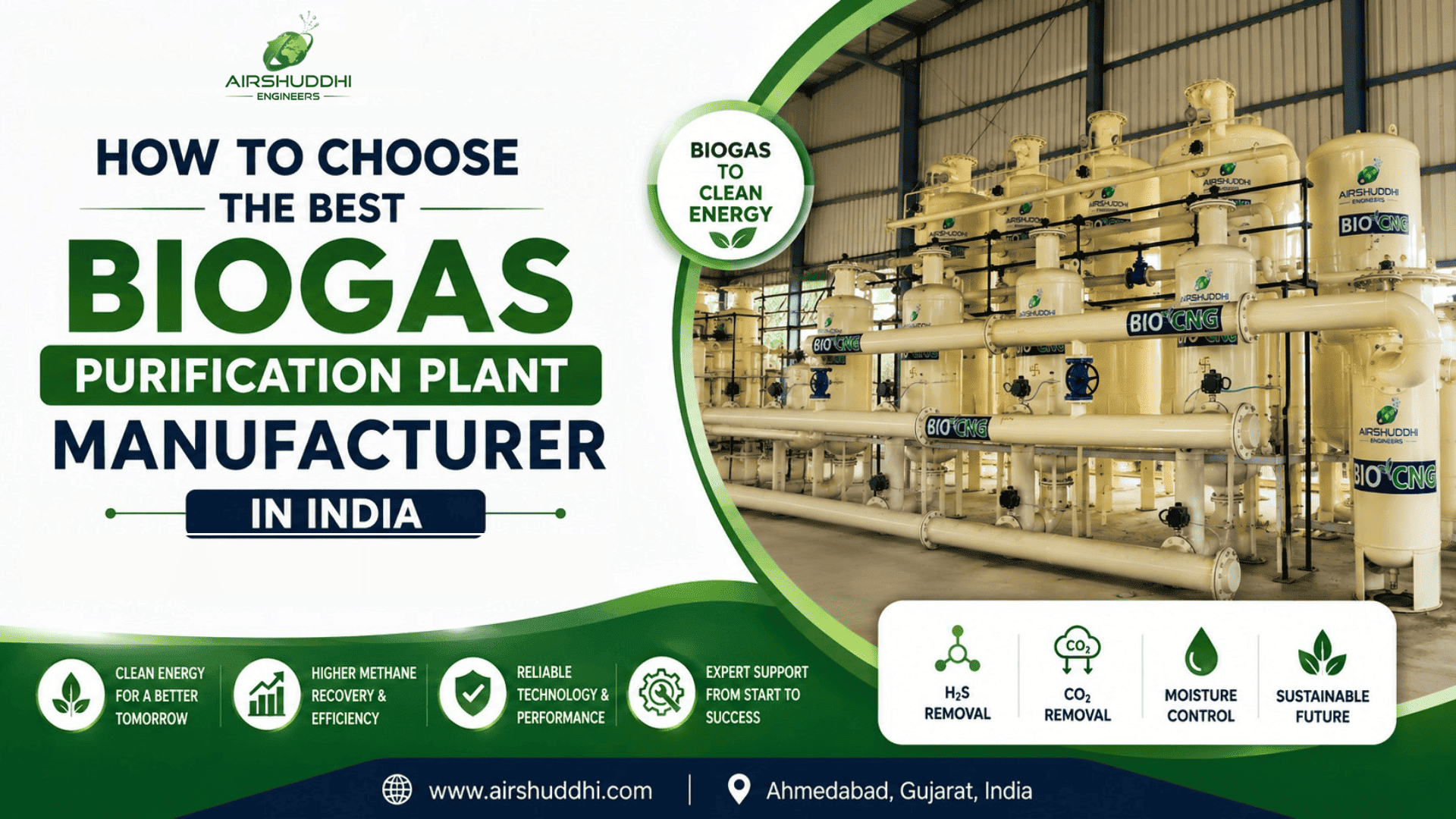
Choosing the right Biogas Purification Plant Manufacturer is one of the most important decisions when planning a CBG, Bio-CNG, biomethane, or renewable-energy project. A purification system must do more than remove impurities from raw biogas. It should deliver consistent gas quality, efficient methane recovery, reliable operation, manageable maintenance, and suitable integration with the rest of the plant.
India's renewable-gas sector is gaining momentum as businesses and project developers look for ways to convert agricultural waste, food waste, cattle dung, sewage, and other organic materials into useful energy. The government's recent ₹23,731 crore push for the GOBARdhan initiative is expected to further support the development of biogas and CBG projects.
For a project owner, however, the growing market also means more technology choices and manufacturers to evaluate. So, how do you identify the right supplier?
A biogas purification plant operates as part of a larger renewable-energy system. Its performance can influence the quality and usability of the final gas.
Raw biogas generally contains methane along with CO₂, H₂S, moisture, nitrogen, oxygen, and trace contaminants. The purification system must be designed around the actual characteristics of the gas rather than a standard configuration.
A reliable manufacturer should understand:
Selecting equipment based only on the lowest quotation can create problems later. A technically suitable system may offer better long-term value even when its initial price is not the lowest.
Before approaching a biogas purification plant manufacturer in India, obtain a proper analysis of your raw biogas.
The manufacturer needs accurate information to recommend an appropriate purification or upgrading technology.
Important parameters include:
Gas composition can vary considerably depending on the feedstock. Biogas produced from cattle dung may behave differently from gas generated from food-processing waste, sewage, agricultural residues, or municipal organic waste.
A good manufacturer should therefore ask technical questions about your gas before recommending equipment.
The required purification level depends heavily on what you plan to do with the upgraded gas.
For example, requirements can differ between:
If the objective is CBG production, gas upgrading and compression become important parts of the overall project.
This is why you should select a manufacturer that understands the complete gas-utilization chain rather than only supplying a standalone purification unit.
Different technologies are suitable for different operating conditions. A manufacturer should be able to explain why a particular technology fits your project.
Common biogas upgrading technologies include:
Pressure Swing Adsorption (PSA) uses adsorption materials and pressure cycles to separate selected components from biogas.
PSA can be considered for projects where gas composition, capacity, required purity, and methane recovery match the technology's operating characteristics.
Vacuum Pressure Swing Adsorption (VPSA) combines pressure and vacuum cycles for gas separation.
When evaluating a VPSA system, project developers should compare gas recovery, energy consumption, gas quality, automation, and operating requirements.
Membrane biogas separation uses selective membranes to separate gases based on their permeability characteristics.
It can be attractive for projects where compact equipment, continuous operation, modularity, and scalability are important considerations.
Hydrogen sulfide requires particular attention because it can cause corrosion, unpleasant odours, and damage to downstream equipment.
A suitable H₂S biogas scrubber or treatment system can therefore be an important part of the gas-cleaning stage.
The best manufacturer should be able to explain the advantages and limitations of each technology instead of recommending the same solution for every project.
Gas purity is important, but methane recovery is equally significant.
Methane represents the primary energy value of biogas. If excessive methane is lost during purification, the project may lose valuable fuel and revenue potential.
When comparing manufacturers, ask about:
A supplier should provide realistic performance expectations based on your actual feed-gas composition.
Avoid making decisions based solely on a headline purity figure. The complete performance of the system matters.
Every purification technology consumes energy in some form.
Electricity requirements can affect the operating cost of a CBG or biomethane project over many years. Therefore, energy consumption should be included in the financial evaluation.
Ask manufacturers for information about:
Comparing lifecycle operating costs can provide a better picture than comparing initial equipment prices alone.
A modern biogas purification plant should be designed for safe and consistent operation.
Important equipment considerations may include:
Automation can reduce manual intervention and help operators monitor important process parameters.
Airshuddhi Engineers' website describes its purification solutions with automatic pneumatically operated changeover valves and PSA modules, reflecting the importance of controlled and automated operation in gas-treatment systems.
One of the biggest mistakes in equipment selection is looking at the purification plant in isolation.
A renewable-gas project may include:
Biogas Generation → Gas Cleaning → H₂S Removal → Purification/Upgrading → Compression → Storage → CBG/Bio-CNG Utilization
Each stage needs to work correctly with the next.
Before selecting a manufacturer, check whether the proposed system can integrate with:
This integrated approach can simplify commissioning and future maintenance.
A genuine technology partner should be able to understand your project instead of simply selling equipment.
Ask whether the manufacturer provides support for:
The manufacturer's engineering capability becomes particularly important when your project involves variable feedstock, changing gas composition, or multiple gas-treatment stages.
A purification plant is a long-term investment. After-sales service should therefore be part of your selection criteria.
Before placing an order, ask about:
A manufacturer that provides strong technical support can help reduce unnecessary downtime and keep the plant operating efficiently.
Airshuddhi Engineers states that its quality commitment includes pre-sale and after-sale customer support and customer satisfaction.
Your current gas production may not remain the same throughout the project's lifetime.
You may later increase:
Therefore, discuss future expansion with the manufacturer before finalizing the initial system.
A scalable design can make future upgrades easier and reduce the need for completely replacing the purification infrastructure.
The purchase price is only one part of the investment.
For a proper comparison, consider:
A low-cost system with high energy consumption or frequent maintenance may become more expensive over its operating lifetime.
The better question is not:
“Which manufacturer offers the lowest price?”
Instead, ask:
“Which solution provides the best technical and economic value for my project?”
Biogas purification projects can vary significantly depending on their feedstock and application.
A manufacturer may need to understand applications involving:
Experience with similar projects can help the manufacturer identify potential process challenges before installation.
India's CBG sector is currently entering an important growth phase. The recently approved national support for biogas and CBG is intended to increase production, strengthen infrastructure, and encourage wider use of renewable gas.
At the same time, industry reporting shows that infrastructure connectivity remains a practical challenge. A recent report highlighted that many CBG plants are operational or under construction but lack planned pipeline connectivity.
This means project developers should think beyond gas production alone.
A successful project needs consideration of:
This wider project perspective can help investors make better technology decisions.
Airshuddhi Engineers, based in Ahmedabad, Gujarat, India, provides gas purification and gas-treatment solutions for renewable-energy and industrial applications.
The company's website currently highlights solutions including:
These technologies address different stages of biogas treatment, upgrading, storage, and downstream gas handling.
Airshuddhi Engineers also focuses on designing and manufacturing gas-related systems and provides engineering and after-sales support for its customers.
For a project developer, the key advantage is not simply selecting a product. It is finding a technology partner that can understand the project's gas characteristics and recommend an appropriate solution.
Before signing a purchase order, ask your shortlisted manufacturer:
Clear answers to these questions can make supplier comparison much easier.
Choosing the right Biogas Purification Plant Manufacturer requires more than comparing brochures and quotations. The manufacturer should be evaluated according to technology suitability, methane recovery, energy consumption, automation, equipment quality, plant integration, engineering expertise, after-sales support, and long-term operating economics.
For CBG, Bio-CNG, biomethane, and other renewable-gas projects, the purification system is a critical part of converting raw biogas into a more valuable fuel.
Before making a final decision, analyze your raw biogas, define the required gas quality, understand your final application, compare suitable biogas upgrading technologies, and evaluate the complete lifecycle cost.
Airshuddhi Engineers, located in Ahmedabad, Gujarat, India, offers biogas purification and gas-treatment solutions including PSA, VPSA, H₂S scrubbing, and membrane-based biogas separation technologies.
To explore solutions for your renewable-gas project, visit www.airshuddhi.com.